


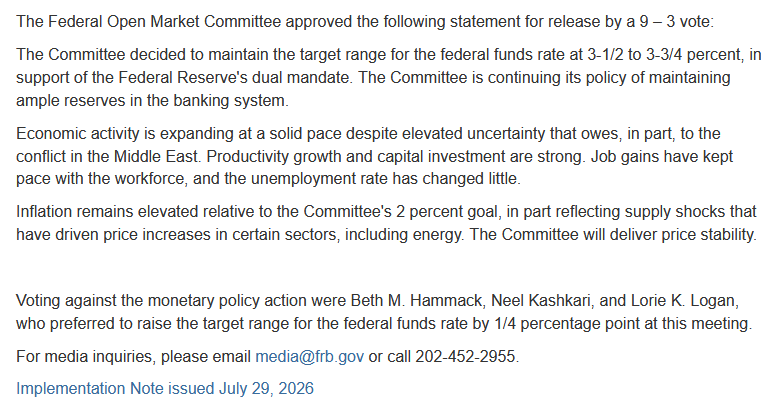
Despite the market assigning a moderate 35% chance of a rate hike at yesterday’s FOMC meeting, the Fed left rates unchanged. However, three dissenting voters (Hammack, Kashkari, and Logan) wanted a rate hike. The Fed Funds futures market is now pricing in near 80% odds of a September hike. The question is whether 3 to 4 additional voters will join their camp and push for a hike in September.
Warsh has made it clear he is in favor of providing less forward guidance. That was made apparent with the shortened FOMC statement that was 166 words, about a third of the size of the statement following Powell’s last meeting. There was also less guidance in his press conference than we have been used to.
Dissenting votes are a factor driving market odds of a September rate hike higher. But the key indicator is Fed Chair Warsh’s opinion of policy. At his press conference, he again heavily stressed his goal of getting inflation back to target and, importantly, dispelled any illusion that there is a higher unspoken target. He also highlighted that nominal and real yields are very high and have “done quite a bit” in terms of tightening monetary policy, which creates a headwind for inflation. Conversely, he acknowledges that extreme capex spending and the oil supply shocks are driving some prices higher.
Warsh provided the market with few clues as to whether the odds of a September hike have changed since their last meeting.
What To Watch Today
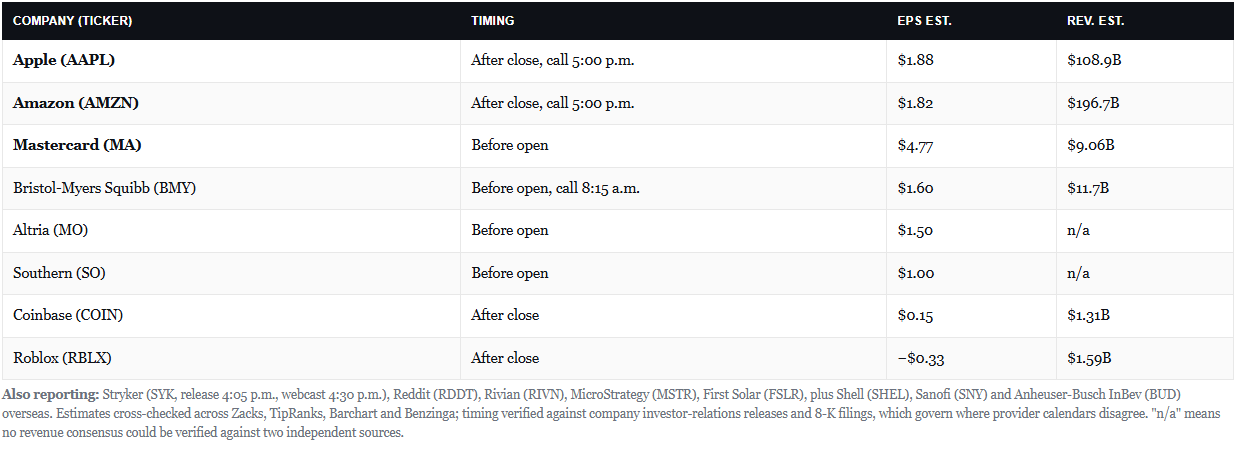
Earnings
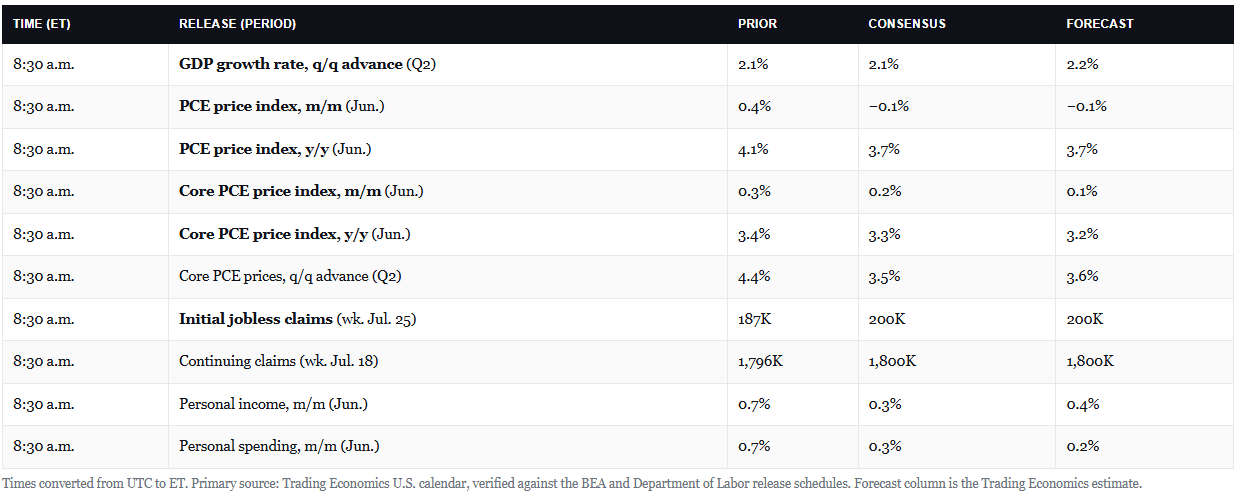
Economy
Market Trading Update
Yesterday, we covered how chip momentum is fading despite strong earnings. Today, the follow-up question. Is this a semiconductor earnings peak, or has the selloff simply gotten overdone?
Start with what Tuesday’s reports actually said. Corning beat on both lines, $0.78 against $0.76 and $4.74 billion against $4.61 billion, then guided third-quarter core revenue merely in line at $4.9 to $5.0 billion. The stock closed down 12.1% on 46 million shares, roughly five times its normal volume. NXP reported after the bell with revenue of $3.50 billion, up 19% from a year ago, growth in every end market and every region, operating margin at 35.1%, and third-quarter guidance about 1% ABOVE consensus. It opened on Wednesday down 4.5%.
Vertiv is the cleanest tell of the three. Revenue growth was strong, sales landed a shade under estimates, management guided higher anyway, and the stock fell 13.8% Wednesday morning to $233.53.
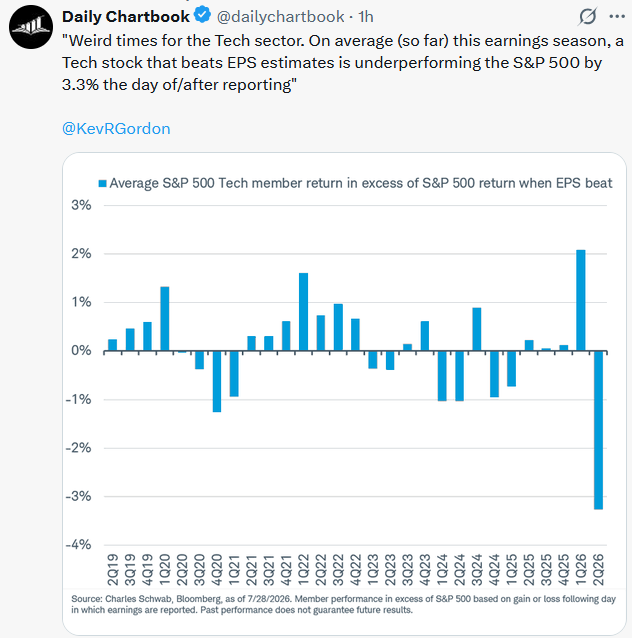
Nobody missed the earnings. Two of the three raised guidance, and NONE of them cut it. The market has stopped paying for beats, and a rounding error on the top line now costs you double digits. That is sentiment, not fundamentals.
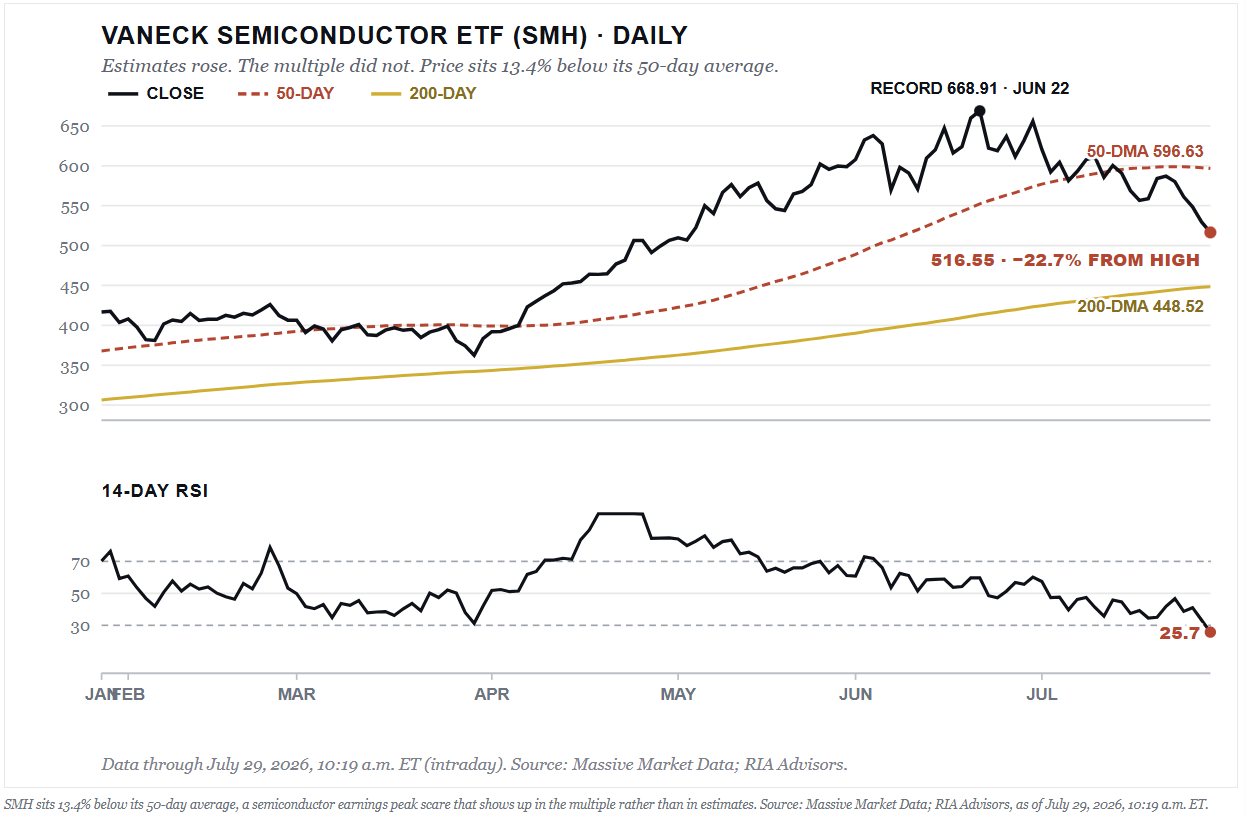
The aggregate tells the same story. Semiconductors and semiconductor equipment are tracking 133% earnings growth this quarter, per LSEG, roughly 44% of the entire index’s earnings gain. FactSet has it at 131% and shows Technology’s bottom-up quarterly estimate rising 8.7% during the quarter, with chips issuing more positive guidance than any industry in the sector. Estimates went up. SMH fell 22.7% from its June 22 record of $668.91. That isn’t an earnings problem; it’s multiple compression.
Where the bears have a case is the second derivative. Beating Intel’s 25% growth quarter against a 25% base is very different from beating an easy comp, and index estimates decelerate from 37.9% this quarter to 27.3% and 24.9%, then 15.3% next year. Peak growth rate is real. Peak earnings are not.
So is it overdone? Notice in the chart above that SMH trades 13.4% below its 50-day average near $596.63, with the 14-day RSI at 25.7. I ran ten years of history on that condition. Thirty-two prior signals averaged a 3.7% gain over the following month and 10.0% over three months, positive roughly seven times in ten.

The honest counter sits at the same table. The worst outcome, down 13.6%, occurred in 2022, when this signal fired repeatedly all the way down. Oversold is not a bottom.
What argues against a repeat is the rotation. The equal-weight S&P 500 closed at a record $217.69 Tuesday, up 13.6% this year, on the very day chips broke. While money fled semiconductors, it did not leave equities.
We are awaiting earnings from AAPL and AMZN tonight, which will wrap up five of the megacap hyperscalers. Once their reports are in, we can re-evaluate our AI complex holdings and determine the next moves. One thing we know, however, is that moves like we are seeing today, rising negative sentiment, and abandonment of positions on a narrative over fundamentals, often provide great opportunities in the future.

Margin Calls Override South Korean Hype
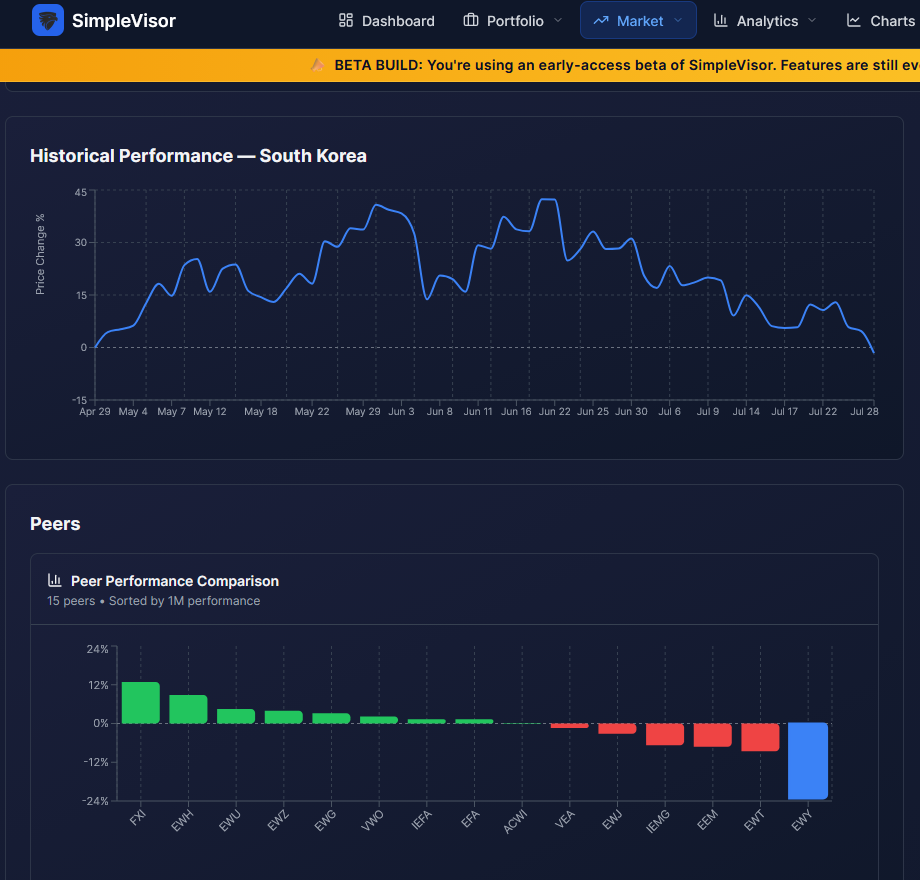
South Korea’s KOPSI stock index triggered another emergency trading halt on Wednesday morning for the second day in a row. The index was down over 8% on Wednesday morning, prompting a trading halt. The suspension of trading followed a nearly 11% fall on Tuesday that triggered a full exchange circuit breaker, shutting down trading. After being the world’s hottest market, led by Samsung and SK Hynix, the KOPSI is down over 40% from its record high in about four weeks.
The KOPSI melt-up and meltdown result from excessive margin-driven speculative trading. Korean retail investors, among others, including US hedge funds, borrowed heavily to ride the incredibly strong rally. Now brokerages are liquidating their accounts as prices drop. Their actions further push prices lower, triggering more liquidations. To wit, Korea has seen 1.2 million margin calls this month with 360,000 accounts wiped out.
This is what happens when the doubt starts replacing hype.
The graphs below from the coming-soon version of SimpleVisor show that the South Korea ETF EWY, a proxy for the KOPSI, has made a 45% round trip over the last few months. Further, it is by far the worst-performing foreign index over the last month.
Carnage In Hyperscaler Credit: Really?
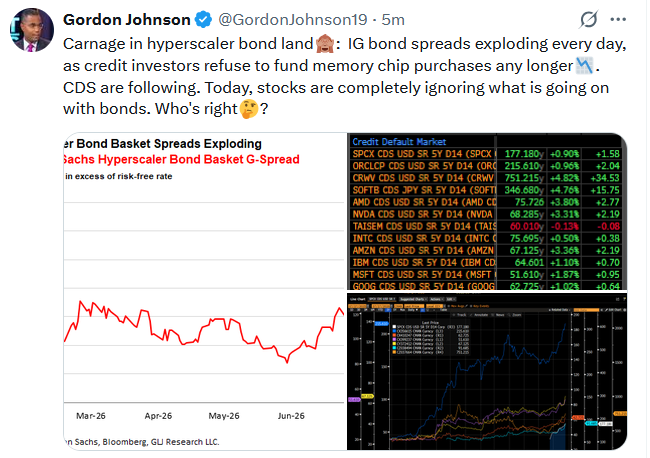
“Carnage in hyperscaler bond land”, claims the Tweet below. The graph below the Tweet shows “exploding” yield spreads for hyperscalers. These hyperbolic messages, along with many others, are generating fear among some investors that the largest hyperscalers are in financial trouble.
The bearish hyperscaler narrative is not all it’s cracked up to be, as we will explain.
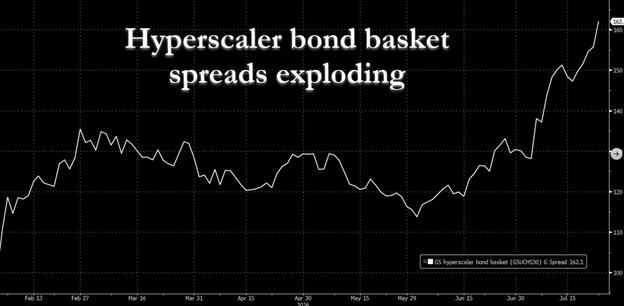
The graph above shows that a basket of credit default swaps (CDS) for the five largest US hyperscalers is “exploding” from 115 bps to 162 bps over the last few months. Given the basket is comprised of some of the largest US companies (Amazon, Meta, Microsoft, Google, and Oracle), the prospect of a credit event for those companies and it potentially spreading to a broader swath of companies would be troubling.

Tweet of the Day
New UPDATED Trading Rules With Desktop Printout
“Want to achieve better long-term success in managing your portfolio? Here are our 15-trading rules for managing market risks.”
Please subscribe to the daily commentary to receive these updates every morning before the opening bell.
If you found this blog useful, please send it to someone else, share it on social media, or contact us to set up a meeting.