


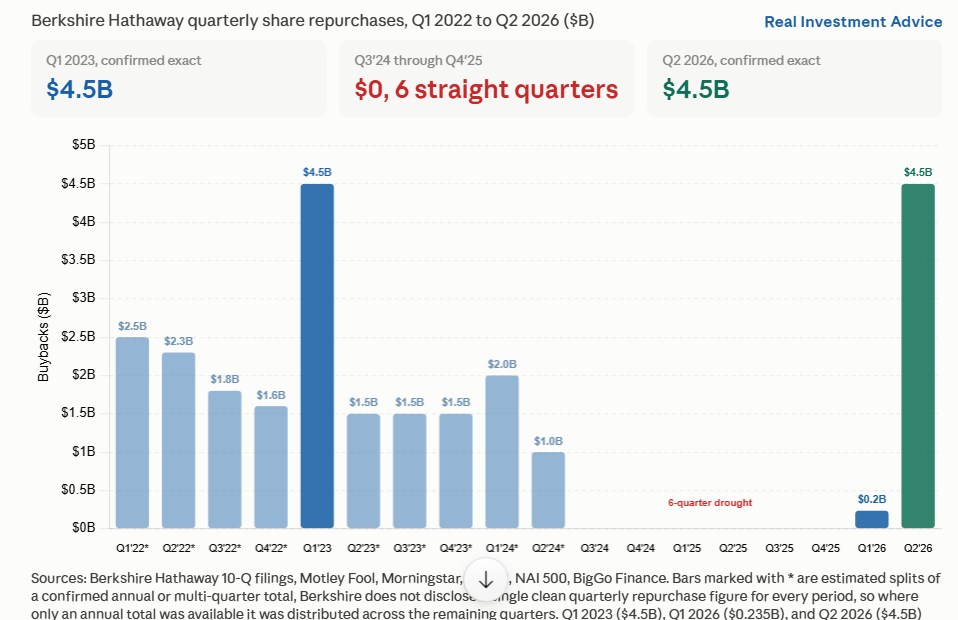
Greg Abel just completed his first full quarter as the CEO of Berkshire Hathaway, taking the throne from Warren Buffett. In his first earnings announcement, Abel sent strong signals of a strategic pivot. Most important of these, Berkshire repurchased $4.5 billion of its own stock in the second quarter, its largest quarterly buyback since a similar amount in 2023, and a sharp jump from $200 million in the first quarter. The quarter also saw Berkshire’s first net equity purchases in 14 consecutive quarters; $39.4 billion was deployed in the first half alone.
In our opinion, the buybacks, not the net purchases of equity holdings, are the most revealing signal, because Buffett spent decades preaching when repurchases are and are not justified. As we wrote in Buffett On Buybacks:
When a company overpays for repurchases, the continuing shareholders lose… gains from value-accretive repurchases benefit all owners.”
In 2016, Buffett stated:
If you’re repurchasing shares above a rationally calculated intrinsic value, you are harming shareholders, just as if you issue shares beneath that figure, you are harming shareholders.“
The recent repurchases should provide shareholders with confidence that some of the best corporate capital allocators see their stock trading at a discount to its intrinsic value. In other words, Abel buying back stock aggressively is him effectively telling the market Berkshire shares are cheap relative to what the business is actually worth.
This year, Berkshire shares have underperformed the S&P 500 despite Abel’s repurchases. Either Abel is wrong about the discount, or the market hasn’t caught up yet.
What To Watch Today
Earnings

Economy

Market Trading Update
Yesterday, we discussed why we rebalanced portfolios on Monday. However, we didn’t aggressively reduce risk because the bullish backdrop remains intact.
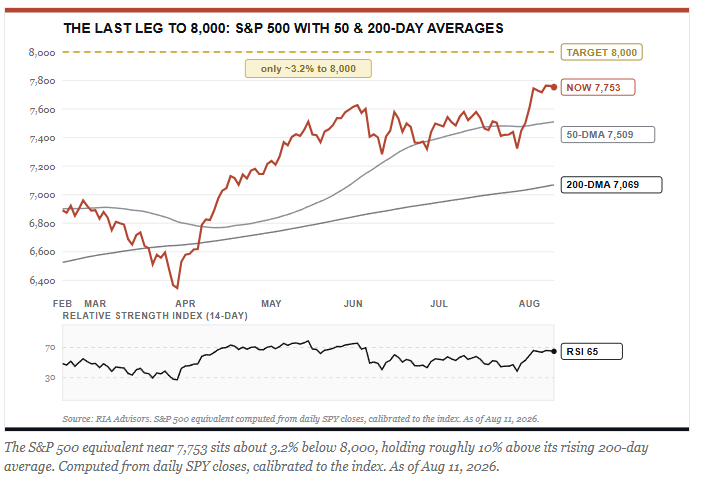
“S&P 500 8k here we come.” That was Goldman partner John Flood’s answer last week when clients kept asking whether the market could keep “digesting” a record wave of new stock. The S&P 500 sits near 7,753 this morning, a hair below Friday’s record close of 7,757, and roughly 3% under the number everyone suddenly wants to talk about. After thirty years of watching Wall Street bolt round numbers onto bull markets, my first instinct with a call like this is skepticism. But here’s the uncomfortable part for the bears: the math behind an 8,000 target isn’t “crazy.” It’s the second half of the story that should worry you.
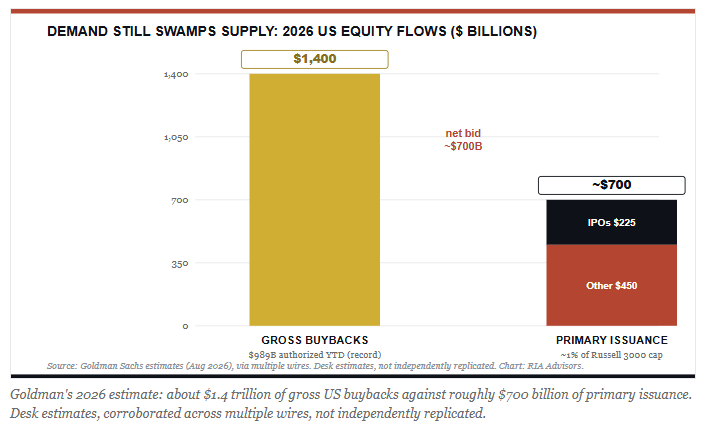
Flood’s argument rests on plumbing, not vibes. Yes, 2026 will be a record year for equity issuance in dollar terms. Goldman pegs corporate supply at near $700 billion, with about $225 billion in IPOs and $450 billion in everything else. Against that sits an estimated $1.4 trillion of gross buybacks, with authorizations already at a record $989 billion year to date and S&P 500 repurchases growing 11% in the second quarter. Do that arithmetic and demand laps supply by roughly $700 billion, even if you assume every unlocked post-IPO share gets sold the day it frees up. Goldman calls the issuance a “manageable headwind,” not a “gale.” On the numbers, that reading is fair. When corporate America is the largest and most price-insensitive buyer in the market, the question of “who’s going to buy all this paper” mostly answers itself.
Now the part Flood’s note glides past. “Why not just chase it?” Because price isn’t the only variable that matters. Start with valuation. The Shiller CAPE sits near 42, the second-highest reading in roughly 150 years, beaten only by the 2000 peak. You’re being asked to pay a “this time is different” multiple for that final 3%.
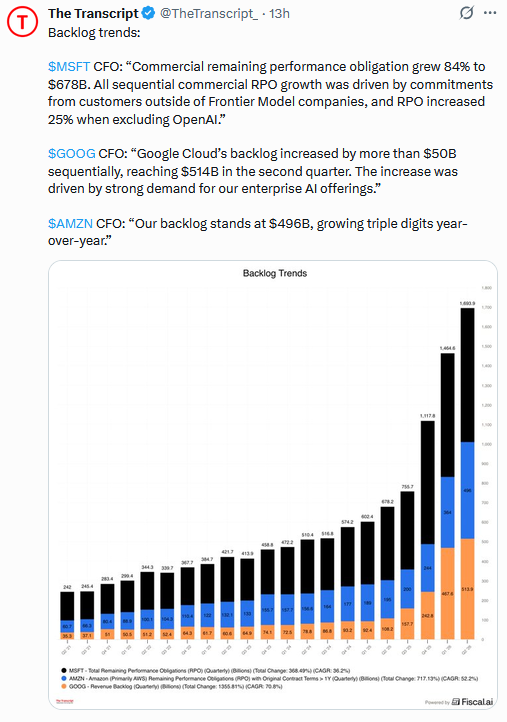
Then look at who is doing the buying. Issuance is freakishly concentrated, with the three largest deals accounting for nearly half of it, AI names at 40% of follow-on volume, and tech, media, and telecom running near 30%. The same hyperscalers propping up the buyback line are the ones shifting cash flow toward capex, with consensus already seeing it topping $1 trillion a year and running past 100% of operating cash flow through 2027. Nvidia just raised half a trillion dollars privately to build more of it. So the “demand” pillar is quietly financed by rising leverage in a handful of names, and such is the tell that a supply-demand model built on buybacks can miss: the buyer and the borrower are wearing the same face.
So is an 8,000 target crazy? No. It’s a coin-flip 3% hop this tape could clear in a month, and round numbers act like magnets right up until they act like ceilings. That’s exactly why we won’t treat it as a “green light.” In our equity models we’re holding target weight, we trimmed the most extended winners back toward their allocations, and keeping a little dry powder rather than reaching for the last leg.
The bottom line is simple. You can respect the bid and still refuse to pay any price for it. Manage risk at the line, keep your quality high, and let the melt-up come to you instead of running out to meet it.

AI For The People: Zuckerberg Lays Out Meta’s Vision
Mark Zuckerberg, CEO of Meta, published a lengthy AI vision statement this week, “The Path to a Positive AI Future,” and its central argument is different from how the large frontier labs like Anthropic and OpenAI describe their mission. Rather than building AI primarily for corporations and governments, Zuckerberg argues Meta’s goal is delivering “personal superintelligence” to individuals, “putting power in people’s hands” rather than allowing it to be concentrated inside a handful of institutions. He writes:
Most other labs are focused on building AI for companies, governments, or other institutions…. so if those labs lead, then the balance of power will favor larger institutions over individuals.
Meta’s philosophy rests on three pillars, which he states plainly in the letter:
- Individual empowerment as “the source of prosperity”
- Invention as “the primary purpose of superintelligence,” not automation
- Balance of power favoring people as “the foundation of safety”
His vision presents concrete benefits to individuals. To wit, every person gets “an exceptionally capable personal agent” that works “24/7 on your behalf” across relationships, health, career, and finances, with “strong privacy and security options” modeled on Meta’s WhatsApp encryption. Per Zuckerberg, “even Meta cannot see or grant access to your information.” He promises free AI access to “billions of people.” He envisions that for more complicated uses, paid compute will be priced through “a dynamic auction mechanism that will guarantee everyone gets the lowest price possible.”
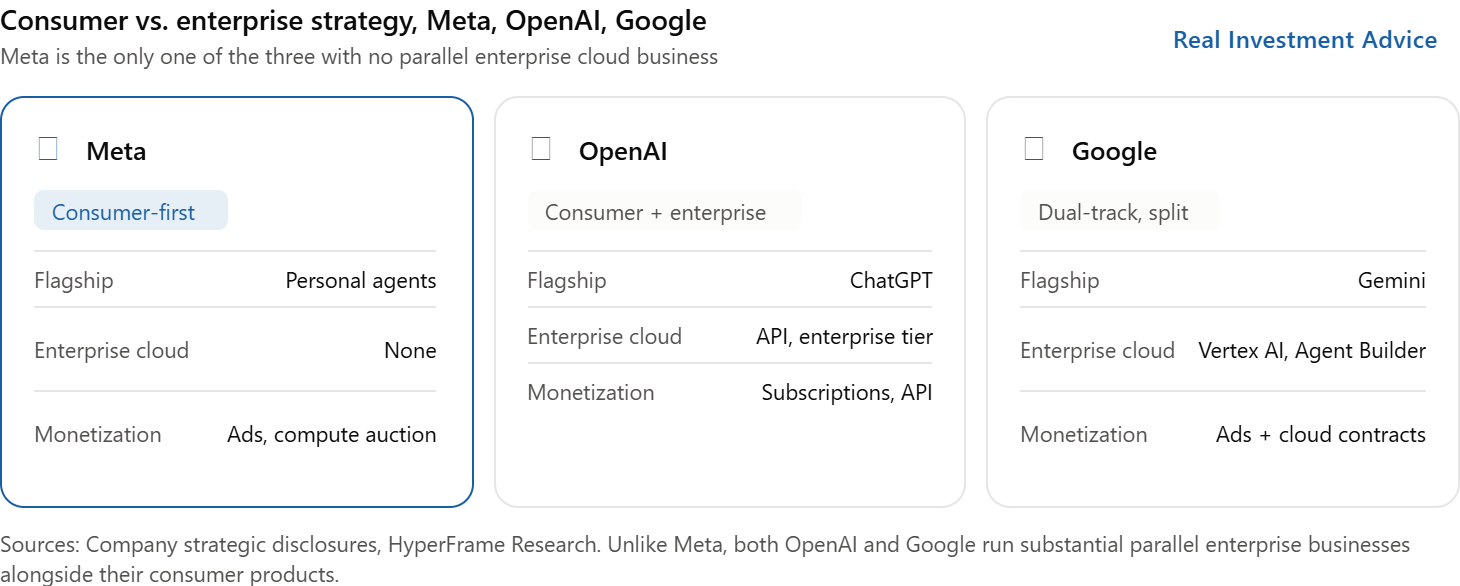
Essentially, Meta is positioning itself as consumer-first, opposing the large labs that sell primarily to corporate and government contracts. While Zuckerberg paints Meta as the sole lab working for individuals, Google’s Gemini is a mass-market consumer product. Demis Hassabis, the CEO and co-founder of Google DeepMind, which oversees Gemini, claims their products benefit “people everywhere.”

Zuckerberg’s Case Against Centralization
In his letter, Zuckerberg makes a contrarian economic claim. He argues broad AI access could produce “even job growth” rather than net job loss, provided the technology empowers individuals faster than it automates their work. He states,
There is no rule that AI must increase automation faster than it increases individuals’ capabilities
To wit, he anticipates “personal biologists,” “world builders,” and “one-person product studios” running companies “at significant scale” with the help of personal agents.
In addition to his economic comments, he also presents philosophical arguments. Zuckerberg rejects the idea that a single, tightly controlled AI system can be made benevolent for everyone. He argues that any centralized system “would have to prioritize some values over others.”
His centralized proposal may look like the following example:
- One person with a superintelligent lawyer creates an unfair advantage
- If everyone has a superintelligent lawyer, justice is restored “more fairly and efficiently“
- The same logic applies to cybersecurity and business competition
To this end, Meta pledges to resume open-source model releases and to give its independent board authority to approve model release safety criteria, an explicit governance check on any single decision-maker, including Zuckerberg himself. He ends his missive as follows:
If these values lead the way, then I am optimistic that the coming decades will be some of the most amazing in history. The arc of human civilization has bent towards putting more power in people’s hands to live and shape the world in the ways we believe are best. Superintelligence holds the promise of giving everyone that power, and building a positive future for everyone.
– Mark

Tweet of the Day
New UPDATED Trading Rules With Desktop Printout
“Want to achieve better long-term success in managing your portfolio? Here are our 15-trading rules for managing market risks.”
Please subscribe to the daily commentary to receive these updates every morning before the opening bell.
If you found this blog useful, please send it to someone else, share it on social media, or contact us to set up a meeting.