


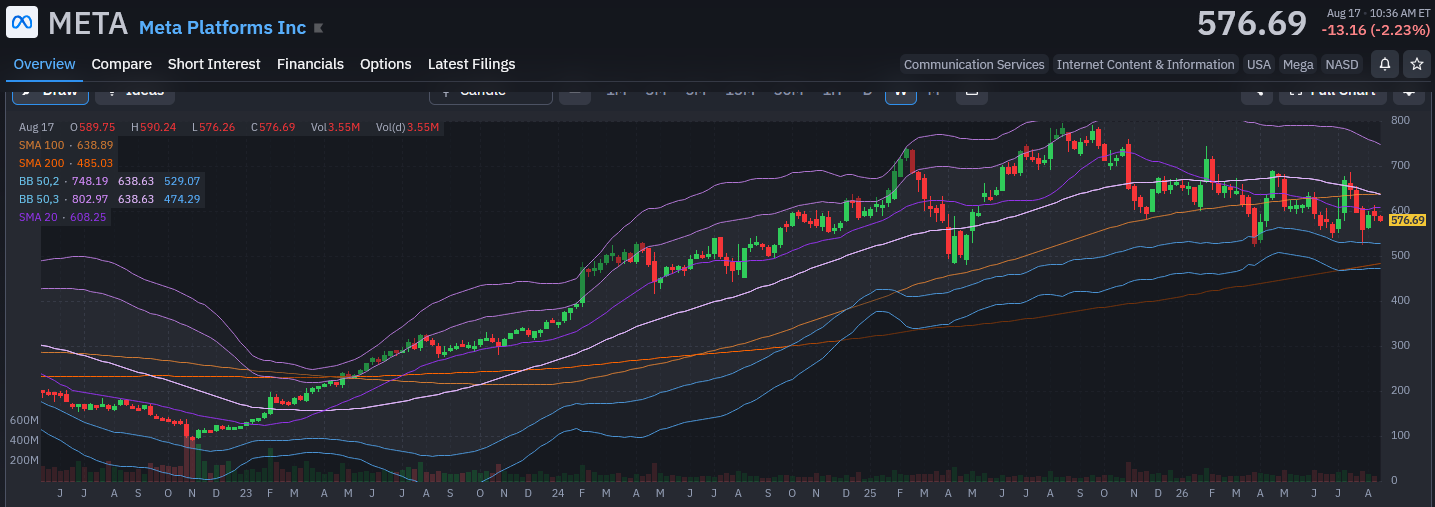
Last week, we wrote two short articles within our Commentary summarizing Mark Zuckerberg’s new stance on AI. We were skeptical of his “AI for the people” essay given his track record. Thus, when we saw a recent Bloomberg editorial, Don’t Buy Zuckerberg’s ‘Good Guy of AI’ Act, we thought it was important to present a counterpoint to his outlook.
The following bullet points summarize some of the editorials more salient points:
The essay’s timing lines up with a political problem, not a philosophical breakthrough. The author connects the piece as a means of countering collapsing “voter sentiment toward AI companies and the data centers they want.” With local construction moratoriums spreading and the coming midterm elections, the author thinks the essay softens data center opposition ahead of a political deadline, with Zuckerberg’s line, “any policy that delayed AI… even a month,” serving as a threat wrapped in friendly language.
Zuckerberg’s “people over institutions” framing rings hollow given Meta’s own history. The author argues Meta’s past strategy, specifically the “thankfully ill-fated Internet.org project,” actually pursued centralized control of internet access, yet Meta is now pushing decentralization. Further, Meta avoids pitching a closed enterprise AI model because “it has so far failed to build a competitive one,” and strengthening pressures from cheaper Chinese open-weight models.
The Richland Parish teacher bonus example omits the other side of the ledger. The author doesn’t dispute the $50,000 bonuses resulted due to Meta data centers, but he notes that Zuckerberg didn’t let the readers know of the state sales tax breaks Meta received or that Meta’s effective US federal income tax rate was a mere 3.5% in 2025.
The $1 billion Future Is for Everyone Fund is short on specifics. The author calls the details “scant” and notes the essay doesn’t explain how funding would scale. He thinks this is more of a PR ploy designed to generate beneficial headlines and sentiment toward Meta, rather than a substantive commitment.
What To Watch Today
Earnings

Economy

Market Trading Update
Yesterday, we covered how July’s weak retail sales knocked another rate hike off the table. Today, we shift from the macro to the mood of the tape itself, because a low VIX is being sold as the all-clear, and it isn’t.
At Friday’s close, the VIX sat at 14.2, its lowest reading of 2026, and it’s parked in the mid-14s again today. Under the surface, something rarer is going on. The Cboe one-month implied correlation index has dropped to roughly 8, among the lowest readings in more than two decades. Read those two together, as the gauges below show. The index looks calm, not because every stock is calm, but because stocks are zigging and zagging on their own and canceling each other out. A compressed VIX is NOT the same as a safe one. It’s a market where a single shock can snap correlations back toward one and light the whole board up at once. We flagged this same split back in July, when the VIX first went quiet.
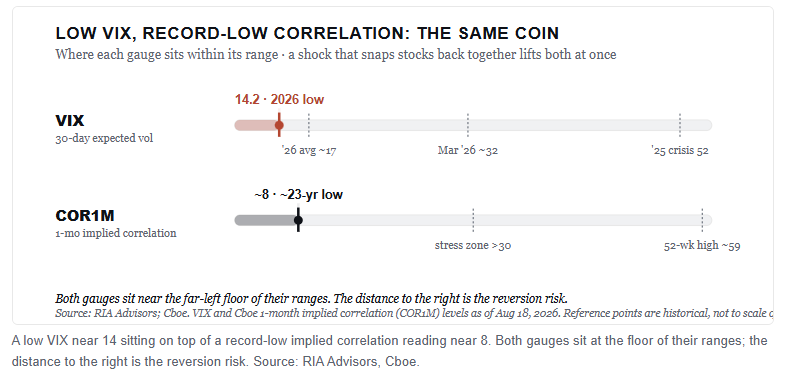
Jonathan Krinsky at BTIG framed the calendar risk this weekend. We’re entering the mid-August to mid-October window that has historically brought the year’s most volatile period, and we’re doing so with the market at record highs and the VIX at its 2026 low. That pattern bites harder in a midterm year. Bob Farrell’s Rule #9 is the older version of the same warning. When everyone agrees the water is safe, it rarely is.
Now layer the price on top of it. As we walked through yesterday, the S&P 500 near 7,770 sits about 10% above its rising 200-day moving average near 7,074, one of the widest gaps of this cycle, with the 14-day RSI back near 73. The chart below shows how far the price now stands from the trend. The 50-day near 7,510 is still well below us, so the uptrend is intact. But the reward for chasing this last leg is thin, and the air pocket underneath it is not.
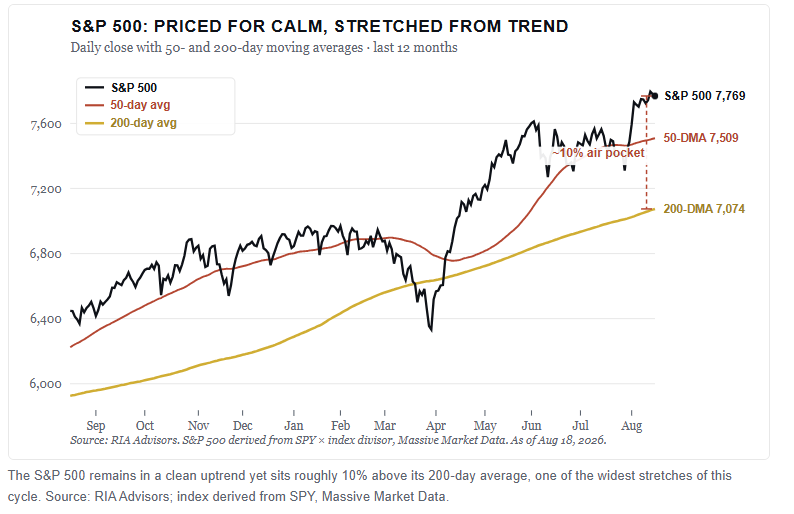
Here’s the part most of the media coverage misses. A quiet VIX isn’t a sell signal, and as we discussed yesterday, we aren’t selling everything and going to cash. However, it does suggest that protection is cheap right as the calendar turns more hostile. We used that strength last week to take profits, and now we are just waiting and watching for the next move.
Critically, don’t confuse a quiet tape with a safe one. Keep participating, but stop paying up at the highs. Trim your most stretched winners back to target, lift portfolio quality, and use these mid-14 VIX prints to hedge the book while the hedge is still on sale. Manage risk into the calm, not after it breaks.

Stock Factors Point To A Healthy Rally
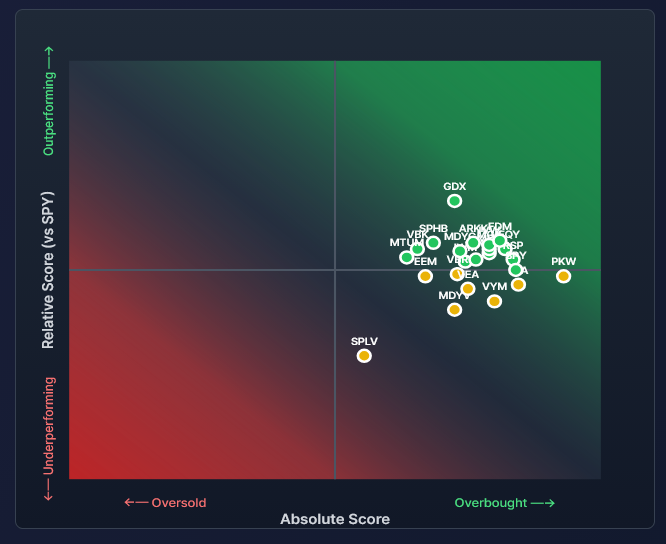
The scatter plot below, showing the key stock factors, paints a picture of a very healthy market. Note that the scores are tightly clustered, meaning different kinds of companies are all generally trading in line with each other. Furthermore, every factor has a positive absolute score, generally pointing to upward trends. Yet, the factors are not overbought. Similarly, the relative scores are all near fair value.
Another way to show this is in our new custom rotation analysis that will be available when the new Simplevisor.ai is released in the coming months. It is currently in Beta testing! For this commentary, we isolated large-cap value (VTV) versus megacap growth (MGK). As the plot shows, they have very similar absolute and relative scores. This suggests large-cap value and growth stocks are performing on par with each other. Most often, one outperforms while the other underperforms. This again points to a market on stable ground, where most stocks are performing similarly.

Think Like An Investor Not A Speculator- Part 1
There is a chart that lands in your feed every few months. It plots a single dollar dropped into the stock market a century ago, which has grown into a small fortune. The caption never changes. Just buy and hold. Time in the market beats timing the market. It looks airtight, and honestly, most of it is true.
However, there is a catch: nobody prints underneath it. That chart was built for an investor who does not exist. If you want to actually build wealth instead of just admiring the math on someone else’s timeline, you have to learn to think like an investor first, and almost nobody explains what that means before they hand you the chart and wish you luck.
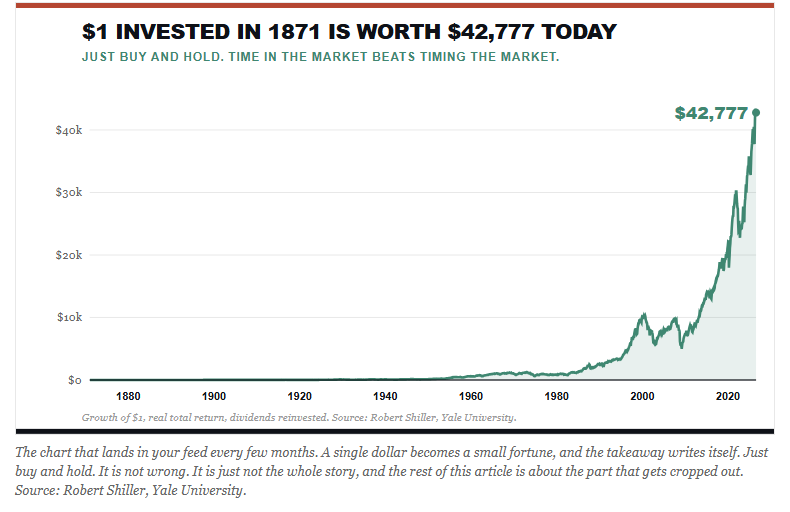
This is the starting point, and it’s not with a stock tip, not with a hot sector, not with the app that promises commission-free riches. Let’s start with the one mental shift that separates the people who keep their money from the people who donate it to the market in waves. It costs nothing, takes about 10 minutes to understand, and will save you from most of the expensive mistakes waiting for you.

Tweet of the Day
New UPDATED Trading Rules With Desktop Printout
“Want to achieve better long-term success in managing your portfolio? Here are our 15-trading rules for managing market risks.”
Please subscribe to the daily commentary to receive these updates every morning before the opening bell.
If you found this blog useful, please send it to someone else, share it on social media, or contact us to set up a meeting.