


The technology sector has been on edge in recent months, in part due to the evolving landscape of AI innovation funding. More specifically, equity investors of the largest AI companies are growing increasingly concerned because debt is being used more frequently as cash flows/profits are no longer sufficient to fully cover capital expenditures. Oracle sparked the concern with a $18 billion debt offering last September, followed by a $25 billion offering in February. Given the large amount of its outstanding debt, Oracle’s CDS implies a junk-bond rating for the investment-grade-rated company. Oracle investors rightly have some concern as it has much higher debt levels than its largest competitors. However, Oracle’s rising debt levels negatively affected shares in companies like Amazon, Google, Meta, and Microsoft.
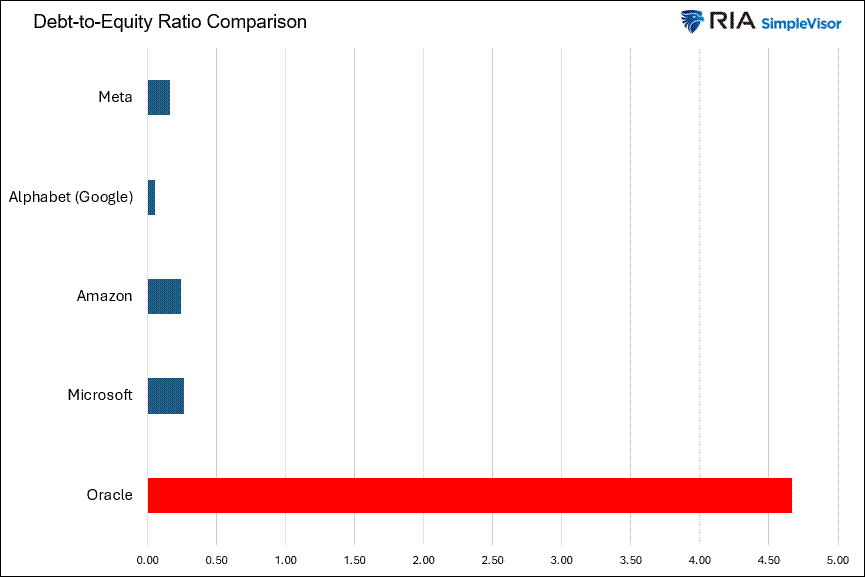
Debt funding will be used more frequently to fund AI innovation. However, as shown in the graph below, the debt-to-equity ratios of companies such as Google, Meta, Microsoft, and Amazon pale in comparison to Oracle’s. Thus, the debt worries might apply to Oracle, but make little sense for those aforementioned companies. To wit, the bond market just proved our point. A new Amazon debt offering generated nearly $4 in demand for every $1 of Amazon debt issuance. It’s also telling that the strong demand for Amazon debt comes amid conflict in Iran and extremely volatile oil prices, both of which are likely to negatively impact the global economy and corporate earnings. It’s also worth noting that corporate bond spreads are among the tightest in history, so investors are clamoring for this new Amazon debt at very expensive levels.
What To Watch Today
Earnings
- No notable earnings releases today
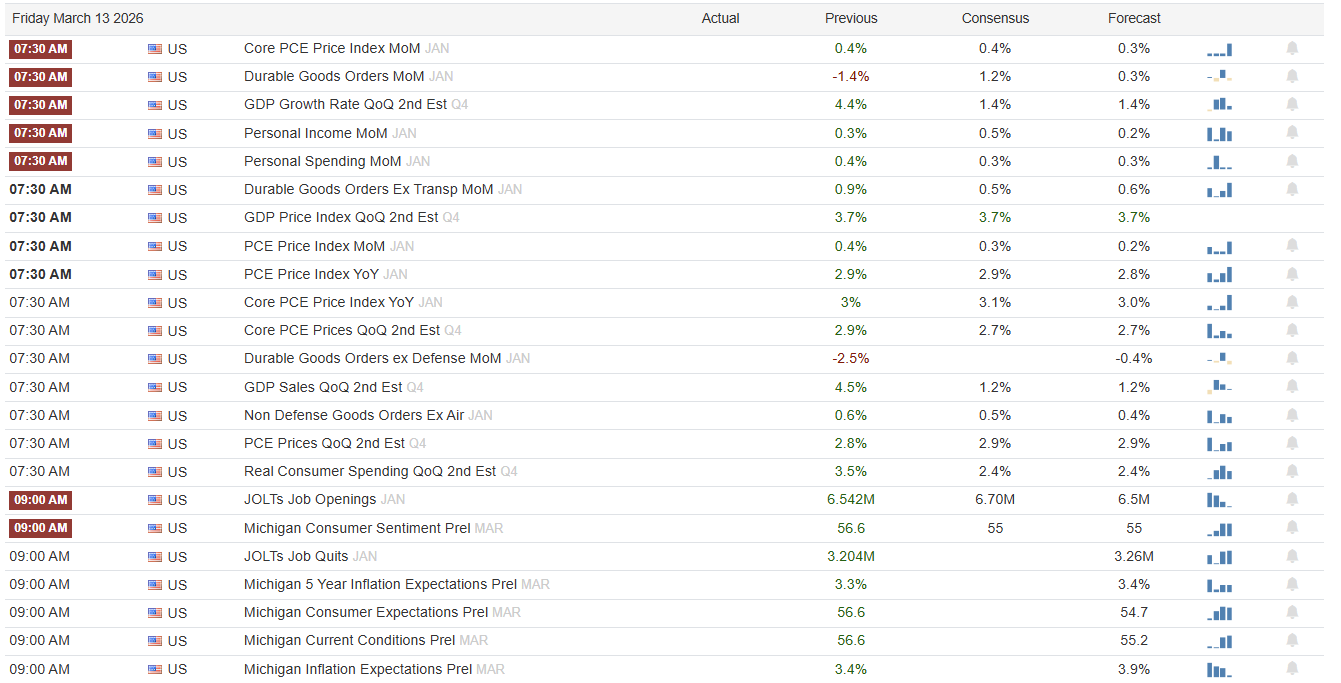
Economy
Market Trading Update
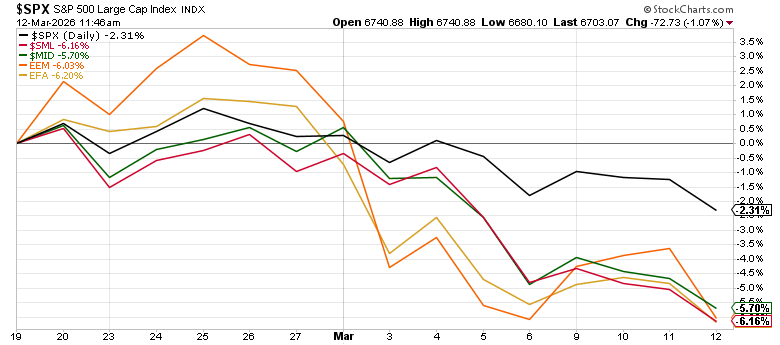
Yesterday, we discussed the ongoing internal battle with the markets as “trapped longs” look for exit points. While the S&P 500 is under pressure, that headline number is masking something far more critical beneath the surface.
While the index itself has pulled back from recent highs, the real damage is being done in pockets of the market that saw the most aggressive momentum chasing at the start of the year. Emerging markets, international equities, small-caps, and mid-caps are getting hit materially harder, and that shouldn’t surprise anyone who was paying attention.
Back in February, we highlighted the extreme bifurcation building inside the market. The perceived “Value-oriented” sectors, like Energy, Materials, Industrials, and Staples, had surged 12–21% year-to-date, while the broader index sat essentially flat. That divergence, driven by the “reflation narrative,” was a warning sign, not a buying opportunity. When capital crowds into slow-growth, economically sensitive sectors while abandoning quality growth, the market’s internal structure weakens. Breadth narrows, volatility rises, rallies shorten, and drawdowns accelerate.
“The current bifurcation inside the S&P 500 raises investor risk as price leadership has shifted toward sectors with weaker fundamental momentum, as noted above. Energy, Utilities, Industrials, and Materials work best when inflation rises, rates rise, and growth stays steady enough to support pricing power. That is the “reflation trade” narrative, but recent economic reports are undermining it as growth slows, inflation and wages fall, and rates decline.”
That’s exactly what’s playing out now.
The momentum chase was lopsided from the start. Investors piling into international and emerging market equities were making a concentrated macro bet that inflation would stay elevated, the dollar would weaken, and global growth would hold. Instead, economic data has continued to soften, inflation is cooling, and the dollar has been more resilient than expected. When a trade this crowded starts to unwind, it doesn’t unwind slowly.
So how should investors navigate this environment?
- First, resist the urge to chase the next narrative. The rotation into value and international wasn’t a structural shift — it was a sentiment-driven overcorrection. Chasing it now, on the back side, compounds the risk.
- Second, quality matters more in a drawdown than in a rally. The growth and technology sectors that were sold most aggressively still hold the strongest balance sheets and the highest margins. When selling pressure is driven by de-risking rather than deteriorating fundamentals, those positions tend to recover first.
- Third, manage what you can control. Tighten stops. Rebalance toward target weights. Reduce concentration in areas that are extended or fundamentally dependent on a macro regime that may already be fading.
The goal isn’t to predict the next move. It’s to avoid being forced out of good positions by accepting too much risk in the wrong ones.
Trade accordingly.

Strive: Fraud Or Stupidity?
Strive Asset Management, the eleventh-largest crypto treasury company, bought preferred shares in Strategy (MicroStrategy/MSTR) to add to its crypto and crypto-related holdings. Per TradingView:
Strive Asset Management (ASST) said on Wednesday it has allocated $50 million of its corporate treasury to STRC, the preferred stock issued by Strategy. The investment represents more than one-third of Strive’s treasury reserves and reflects growing institutional interest in yield-generating securities linked to Bitcoin-focused treasury strategies, according to a company announcement.
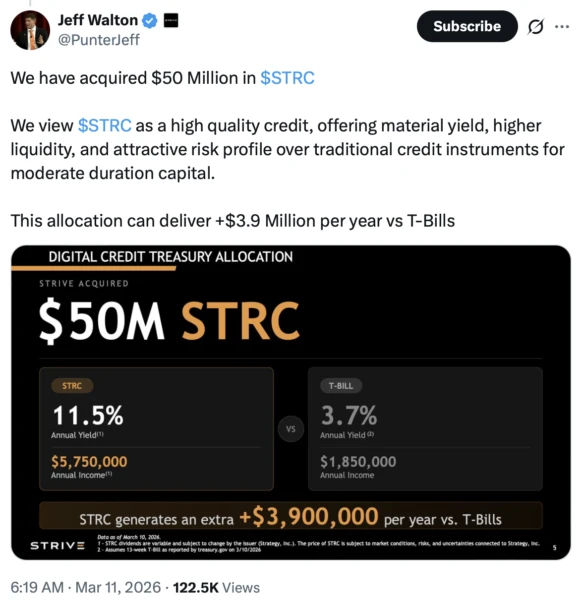
At first blush, the deal makes sense as explained by its Chief Risk Officer, Jeff Walton, in the Tweet below. Notably, the $50M STRC purchase was drawn from existing cash reserves as Strive held roughly $143.4M in cash and equivalents before the transaction. This past January, Strive issued a 12.75% preferred offering ($225M) that was primarily used to retire ~$110M in debt from the Semler Scientific acquisition and to pay off a Coinbase loan.
What is important is that the cash used from that offering at 12.75% is being used to buy STRC preferred stock yielding 11.50%. The negative carry is a crucial risk on a blended cost-of-capital basis, as Strive’s outstanding preferred obligations cost more than what STRC yields
Furthermore, the STRC note is a variable rate (Variable Rate Series A Perpetual Stretch Preferred Stock), meaning the 11.5% current yield can change. By allocating a third of its balance sheet to a trade that will have to cover a negative carry, Strive introduces further basis risk. Moreover, Strive risks bankruptcy if Strategy cannot make payments on its preferred debt or defaults on it. Even more confounding, Strive doesn’t benefit if Bitcoin and/or Strategy shares rise, as it is buying preferred shares with no equity stake.
We have no logical explanation for why Strive would do this deal, so we asked Claude.
The “nesting doll” systemic risk: Several analysts have flagged this as the more profound concern. Strategy raises money via STRC and uses proceeds to buy Bitcoin. Strive holds Bitcoin and buys STRC. Both entities’ ability to service preferred obligations is ultimately correlated to the same underlying asset — Bitcoin. This isn’t diversification; it’s concentrated, layered exposure. If Bitcoin drops sharply, Strategy may struggle to service STRC, precisely when Strive’s own balance sheet is also under stress.
Unless we are missing something, this transaction bodes poorly for Strive shareholders. Not surprisingly, Strive shares are down 97% since last May, following a 20-for-1 reverse split, as shown below. In other words, shareholders are already evaluating management’s capital-allocation track record.

Tweet of the Day
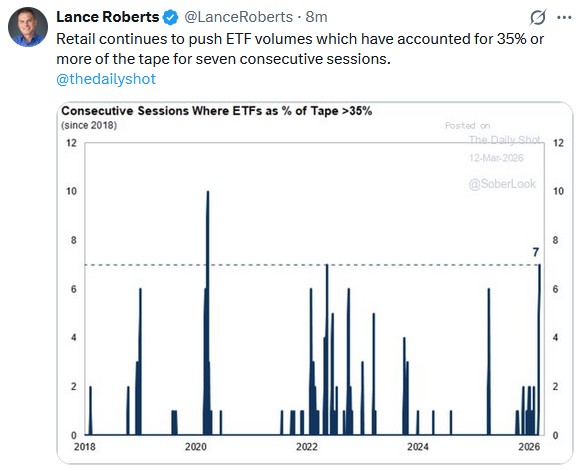
“Want to achieve better long-term success in managing your portfolio? Here are our 15-trading rules for managing market risks.”
Please subscribe to the daily commentary to receive these updates every morning before the opening bell.
If you found this blog useful, please send it to someone else, share it on social media, or contact us to set up a meeting.