By Michael Lebowitz and Lance Roberts | November 17, 2026
Share
Anthropic’s IPO (ANT) will price tomorrow and start trading on Thursday. The company is offering 825 million Class A shares at $70 to $78 per share, raising up to $64.4 billion. Additionally, they are conducting a $26 billion private placement, bringing the total to about $90.4 billion and a valuation of roughly $1.3 trillion. The buyers of the private placement are worth noting. AMD, Broadcom, Google, Micron, Microsoft, Nvidia, and TSMC are committing to $26 billion of shares at the IPO price. Those companies are Anthropic’s suppliers and partners. They are funding Anthropic because Anthropic will use the money to buy their chips and cloud capacity. This is the same circular pattern we described in Nvidia’s financing arrangements.
Arriving after the SpaceX listing and alongside some of the hyperscalers issuing stock, we think the equity supply question matters more to the market than the valuation debate. On the supply side, SpaceX pulled $75 billion out of the market in June, and investors sold other holdings to fund it. Goldman estimates roughly $700 billion of total US equity issuance this year, with IPO proceeds alone already eclipsing the prior full-year record. In dollars, these are records, but measured against the size of the market, they are not, sitting below both 2021 and the dot-com peak.
Goldman expects about $1.3 trillion in gross buybacks this year, with the buyback yield heading toward its lowest level in roughly 15 to 20 years outside recessions. As we wrote in The Market’s Biggest Buyer Is Stepping Back, buybacks have been the marginal bid in the market. Goldman still expects demand to absorb supply this year, but points to 2027, when that may change as IPO lockups expire and the big hyperscalers continue issuing more equity while halting buybacks.
What To Watch Today
Economy
Time (ET)
Release (period)
Prior
Consensus
Forecast
8:30 a.m.
Retail Sales MoM (Oct)
0.8%
0.2%
0.6%
8:30 a.m.
Retail Sales Ex Autos MoM (Oct)
0.9%
0.4%
0.5%
8:30 a.m.
Retail Sales Control Group MoM (Oct)
0.1%
0.4%
0.1%
8:30 a.m.
Import Prices MoM (Oct)
1.1%
0.7%
0.8%
9:15 a.m.
Industrial Production MoM (Oct)
0.7%
0.1%
0.3%
9:15 a.m.
Capacity Utilization (Oct)
76.9%
76.8%
76.9%
10:00 a.m.
NAHB Housing Market Index (Nov)
29
29
29
Source: Trading Economics; release dates and times confirmed against the U.S. Census Bureau and Federal Reserve Board calendars. Real Investment Advice | RealInvestmentAdvice.com
Earnings
Company (Ticker)
Timing
EPS est.
Rev. est.
Home Depot (HD)
Before open
$3.86
$42.69B
Walt Disney (DIS)
Before open
$1.67
$25.26B
Nvidia (NVDA)
After close
$2.47
$109.0B
Source: Company investor relations announcements, Earnings Whispers, Market Chameleon. Real Investment Advice | RealInvestmentAdvice.com
Fed speakers: St. Louis Fed President Musalem (7:30 a.m.), Governor Waller on payments at The Clearing House conference (9:10 a.m.), Cleveland Fed President Hammack (9:30 a.m.), and New York Fed President Williams (2:25 p.m.). All times ET.
Market Trading Update
Yesterday, in Nvidia Circular Financing: Who Is At Risk?, we noted that Staples sat 9.2% above its relative trend, tied with Health Care as the most stretched sector in the market. Today, we dig into that consumer staples bubble, because the “safe” trade is now the crowded one.
The Consumer Staples ETF (XLP) closed Friday at $92.35, its highest close in more than a year. That puts the sector up 18.9% this year, ahead of Technology (XLK) at 18.3% and miles ahead of Discretionary (XLY), which is up less than 1%. Notice how quickly that happened in the chart below. On October 2, the staples-to-tech ratio sat 25% below where it started the year. Six weeks later, it’s back to even. That’s a 34% relative swing in a sector built to be boring.
Here’s where it gets interesting. BTIG, via The Market Ear, notes the only comparable 30-day burst of staples over tech in roughly 25 years came between April 2000 and October 2001. Goldman’s data shows the staples valuation premium to the S&P 500 at its widest in more than a decade. The sector’s dividend yield relative to the 10-year Treasury sits in the 1st percentile. Investors aren’t buying staples for income. They’re buying shelter, and paying a record price for it.
Then there’s positioning. Morgan Stanley’s prime brokerage reports hedge funds are net long staples for the first time since October 2025, driven largely by short covering. In other words, when the defensive trade becomes the consensus trade, it stops being defensive.
The technical picture confirms the stretch. XLP sits 8.8% above its 200-day moving average at $84.89 and 7.8% above its 50-day at $85.65. Friday’s close landed just under the upper 2-standard-deviation band at $93.02, with the weekly RSI pushing 70. We’ve seen this setup before. On February 27, XLP closed 11.5% above its 200-day. By March 24, it had given back 10% and was sitting right on that average.
Goldman’s work shows that after similar staples rallies, relative returns over the following three months have typically been negative. That doesn’t require a crash. A simple reversion to the 50-day is a 7% decline, and a trip to the 200-day is roughly 8%. For a sector bought as “safety,” that’s about three years of dividend income gone in a few weeks. Such is the math of overpaying for safety.
For portfolios, the action is straightforward. In the ETF Sector Rotation Model, we trimmed XLP back to target weight into strength, NOT chasing it. Keep a trailing stop at the 50-day near $85.65. If Nvidia’s report Tuesday night steadies tech, the rotation that built this trade can reverse just as fast.
Safety bought at any price isn’t safety. It’s just the next crowded trade looking for an exit.
Understanding What You Own: Style Analysis
We recently discussed how some stocks that the market puts in the “value” category aren’t value, and others many associate with growth are also value. To wit, we ended a recent article, The Value Rotation Illusion, as follows:
The funny thing is that in this value rotation, many investors are unknowingly shifting from value stocks to expensive ones.
The takeaway is that while the value and growth monikers are pushing billions and dollars into and out of different sectors and factors, its important to understand what you truly own. To help investors, our new version of SimpleVisor introduced a new style analysis tool. Our tool follows the CRSP value/growth style framework: a multi-factor value composite and a separate multi-factor growth composite, both measured against the same universe of stocks.
The graphic below shows the growth and value scores for each S&P 500 stock, its primary sectors and our equity portfolio (blue star). You can easily zoom in on the graph to find stocks with certain growth or value traits. For instance, in the second graphic we zoomed in on the upper right “Growth & Value” quadrant. It shows that SMCI has the highest growth and value score. When zoomed out, you can hover over dots to see which stock they are. Moreover, you can use the “custom” feature to search for stocks. As we highlight in the third graphic, Apple is slightly a growth company with below average value traits. It sits to the lower left of the technology sector.
A Leveraged ETF: That Math Doesn’t Work The Way You Think
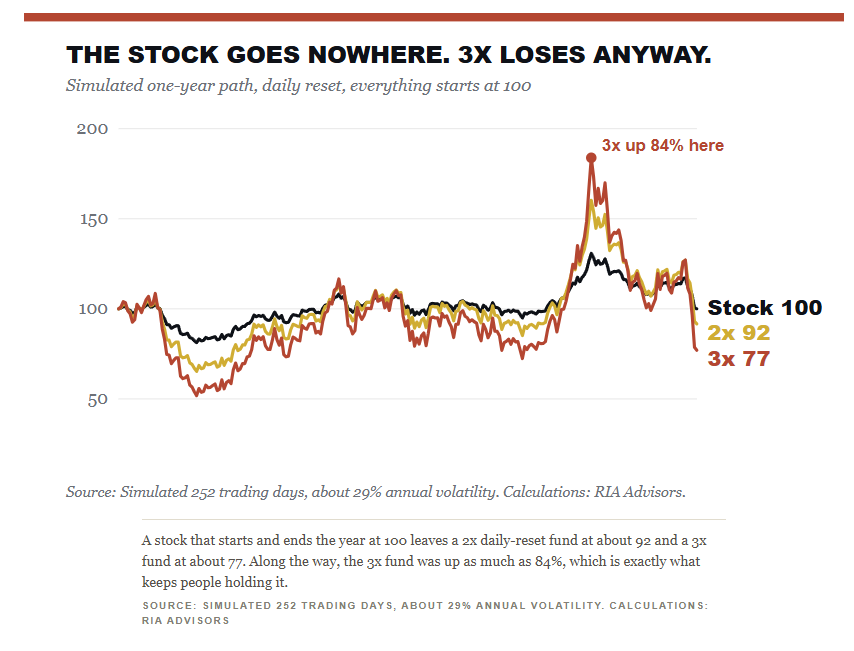
Before you buy a leveraged ETF, do yourself a favor and READ the prospectus first. You will find that the“promise”is very precise. A 2x fund aims to deliver twice the return of its benchmark for a single day. Not for a month or a year, just for one day. The fund rebalances every afternoon to restore its leverage, and that daily reset is the entire story.
The regulators have been blunt about this for a long time. To wit:
“Therefore, inverse and leveraged ETFs that are reset daily typically are unsuitable for retail investors who plan to hold them for longer than one trading session.” – FINRA Regulatory Notice 09-31, June 2009
The SEC’s updated investor bulletin says the same thing, calling these “specialized products that generally are not suitable for buy-and-hold investors.” The warning is old, but the marketing is brand new. Such is the problem: the people buying these funds today mostly weren’t investing in 2009, and nobody hands them that notice before the app lets them place the trade.