


Rapidly warming ocean waters almost ensure an El Niño condition by July. El Nino is a periodic warming of ocean surface waters in the central and eastern Pacific Ocean that disrupts normal weather patterns globally. El Nino patterns can cause droughts in some regions and excessive rainfall in others. This expected episode is much stronger than normal. To wit, Michael Snyder labels it a “Godzilla El Nino.” Assuming it persists through at least year-end, as is typical, it could have a significant impact on farming and fishing and, ultimately, on food supplies and prices.
Previously, stronger El Nino conditions have delivered major supply shocks to agriculture, fisheries, and food supply chains by disrupting rainfall and temperature patterns. For instance, some analysts expect the current El Nino to usher in drought conditions for growers in Indonesia, India, and parts of Australia. In Central America, the Caribbean, and Colombia, severe dryness threatens maize and rice crops.
It’s not all bad news. If the El Nino shifts the Pacific jet stream south and east, it will likely bring wetter conditions to the southern US and parts of the US Plains. Such a rainfall pattern could be beneficial for some drought-ridden US growing regions. Furthermore, Brazil tends to benefit from El Niño rainfall on its soy crops, and Southern Africa is projected to have above-average cereal output for 2026.
The broader concern is the convergence of El Nino with soaring fertilizer prices. The six-to-twelve-month lag in El Niño’s production impact aligns with the lag observed in the Strait of Hormuz fertilizer disruption. Analysts estimate that three to four million tons of fertilizer supply have been cut since the closure. Two independent supply shocks with similar lags are converging on the upcoming crop cycle. Per the Commodity Report via Substack:
The El Niño yield hit arrives in 2027. The fertilizer input shortage hits the 2026 growing season that El Niño is already stressing. Two independent supply shocks with similar lag structures are converging on the same crop cycle in the same window.

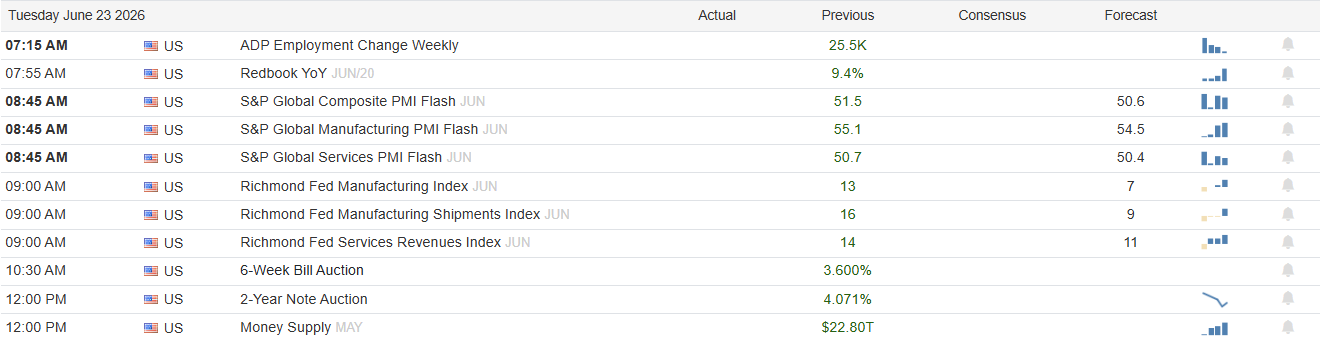
What To Watch Today
Earnings

Economy
Market Trading Update
Yesterday, we discussed the market’s technical backdrop following the holiday-shortened trading week. Also, on Monday, we discussed the risk of the next two weeks as we approach the end of the quarter. However, with all that said, there is something about this tape that should bother you, and it isn’t the price action. The S&P 500 is hovering around 7,500, just shy of the 7,620 high set earlier this year, and the VIX is parked near 16. On the surface, it is very calm, but that is the problem.
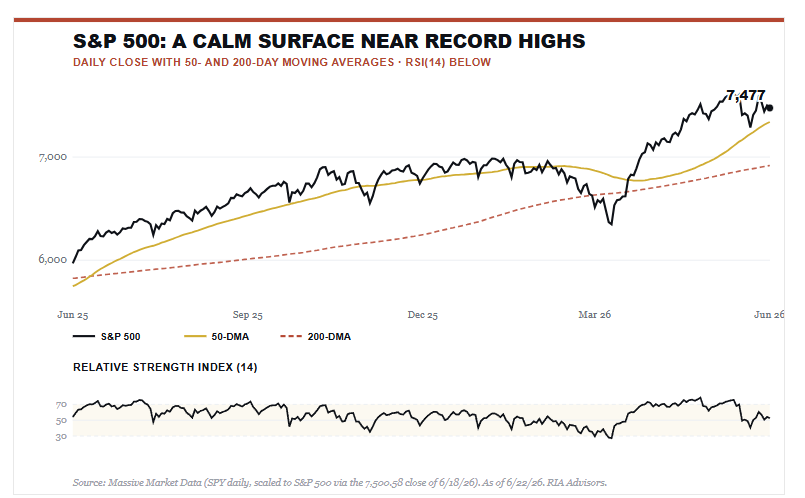
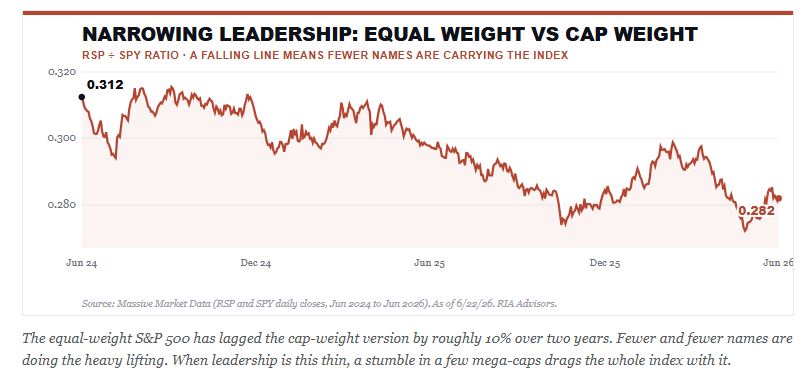
Make no mistake, the risk in this market isn’t the chart. It’s the plumbing underneath it. Over the past decade, the market’s structure has quietly changed in ways that get celebrated on the way up and turn vicious on the way down. Passive funds now set the marginal price across huge swaths of the index. Zero-day (0DTE) options dominate daily options volume. Leveraged and single-stock ETFs have multiplied to where the listed-product count rivals the number of actual companies. Margin balances sit near records. And concentration in a handful of mega-cap names is the most extreme we’ve ever measured.
Strip away the labels, and it’s really just one trade. Unfortunately, the majority of the market seems to be on the same side of the boat, worshipping price momentum rather than value. Bob Farrell’s Rule #9 covers this: when all the experts and forecasts agree, something else is going to happen. The crowd has rarely been this lopsided.
However, here’s what people forget. Momentum is a two-way street, and it travels faster DOWN than up. The same passive flows, leverage, and reflexive options hedging that lift the tape on the way up reverse hard the moment the flows turn, and they tend to do it without warning and without giving anyone time to reposition. You don’t need a recession to set it off. October 1987 and the 2018 “Volmageddon” weren’t macro events. They were structure-related events in which the market’s own wiring turned a small spark into a fire.
What lights it? We all have a list of candidates from a reacceleration in inflation, a failed Treasury auction, a crack in semis, a sharp drop in crypto, a geopolitical shock, or evidence that the AI capex boom won’t earn its cost of capital. While you can pick your poison, it likely won’t be any of those issues that are already well known by the market. The honest answer is that the trigger usually isn’t on anyone’s list. It is an unexpected, exogenous event that shocks the market, causing investors to revise expected earnings downward. The fragility is the story. The catalyst is just the match.
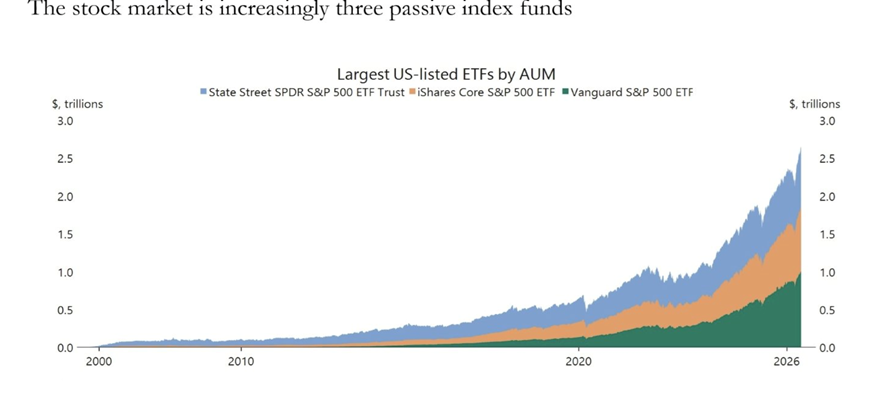
We’ve flagged the passive-flow problem before, and the pushback never changes: the trend is your friend, and timing the unwind is impossible. Fair enough. I’m not telling you to dump everything into a market printing new highs. I’m telling you that when the structure that powered the climb runs in reverse, it won’t wait for permission. As Doug Kass noted on Monday, the market is now being driven by three passive index funds in which 40 cents of every dollar goes into just 10 stocks.
The bottom line is simple. Don’t confuse a quiet tape with a safe one. Keep some dry powder, mind your stops, and stay disciplined while the crowd stays comfortable.

The Wavering Breadth
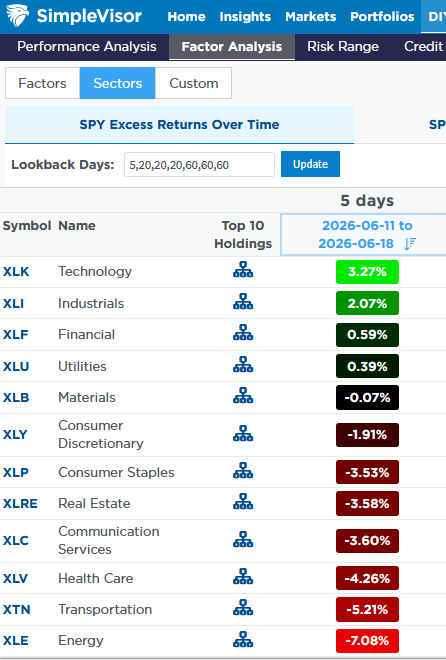
Breadth deteriorated last week. Consider that with the S&P 500 up nearly 1% on the week, half of the sectors underperformed the index by 3.50% or more. It’s worth noting that one of the few sectors to outperform was financial stocks, which beat the S&P 500 last week despite the Fed’s hawkish tone. Typically, a flattening yield curve and the threat of rate hikes bode poorly for financial stocks. Were skeptical that this can continue. Let’s see whether the financial sector can continue to outperform or whether the new Fed reality catches up with it.
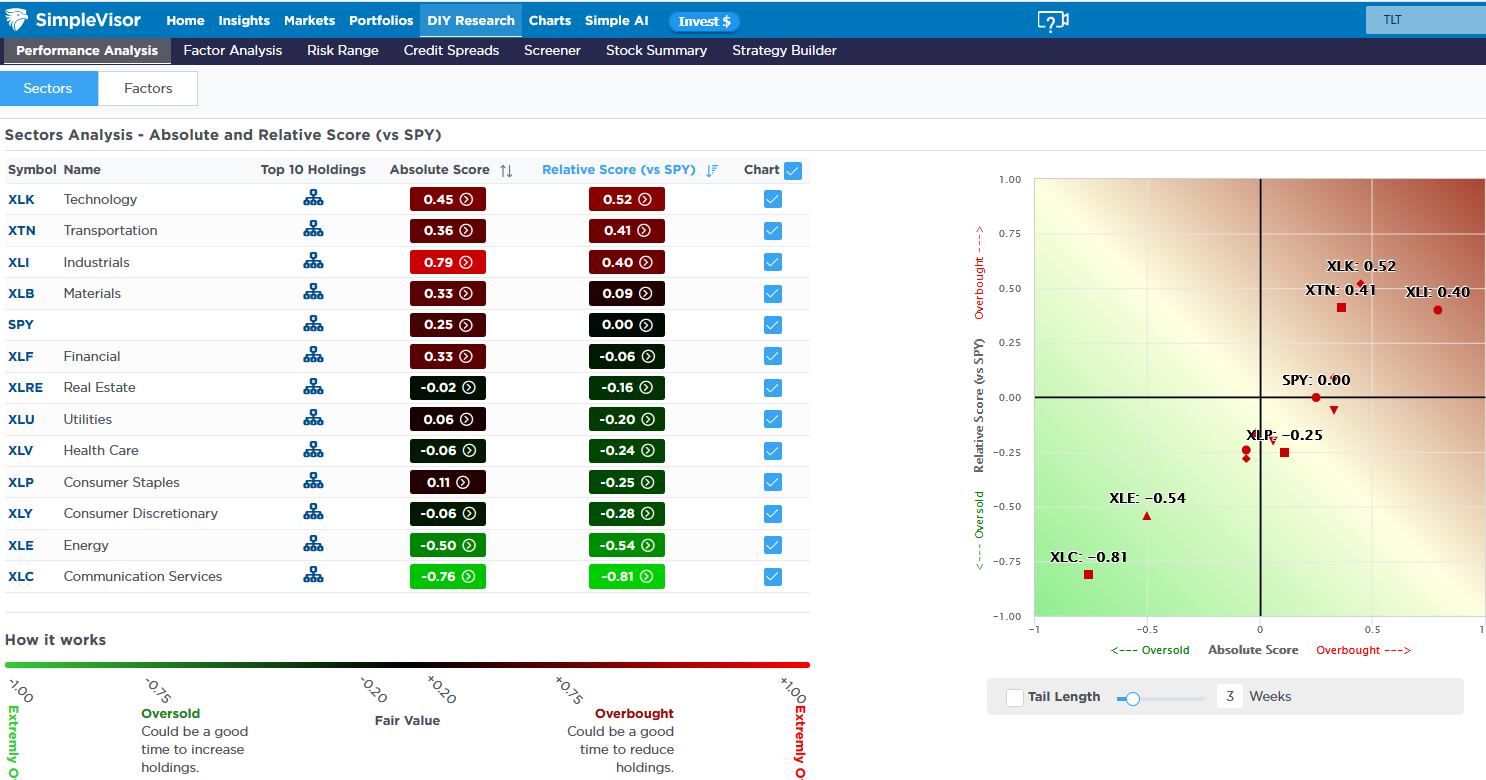
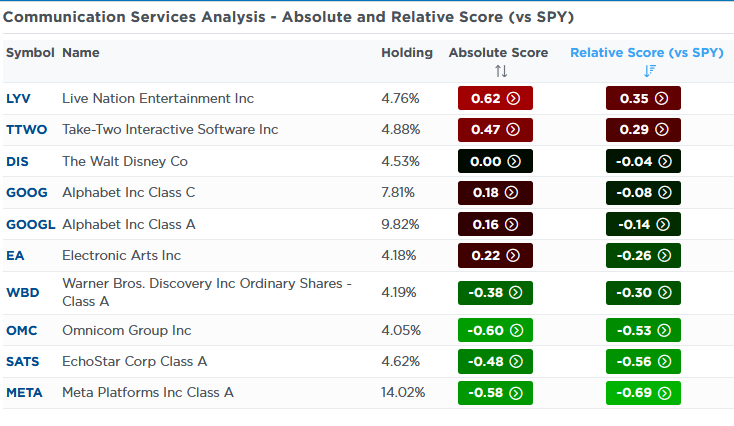
The second graphic shows the wide dispersion in absolute and relative scores. If you recall, last week’s scores were more aligned near the graph’s center. Industrial stocks have joined technology and transportation stocks in the overbought quadrant. While they are overbought, they are not exceedingly overbought. However, the communications sector is now getting extremely oversold. Meta stock, which accounts for nearly 15% of the sector, is one reason for the sector’s poor performance. The other large contributor, Google, sits around fair value. We break down the sector’s top 10 holdings in the third graphic.
The Technical Backdrop: When Flows Meet A Hawkish Fed
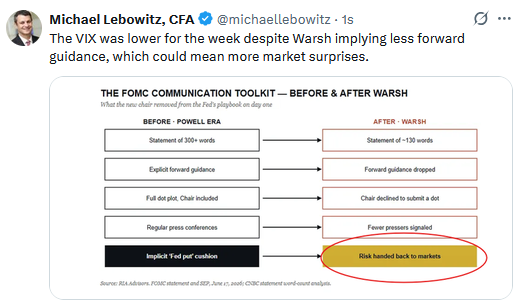
Here’s the setup most investors are underrating right now. Over the next two weeks, the tape will trade on plumbing rather than fundamentals. We just cleared the largest options expiration in history. Quarter-end pension selling comes next, and then July 1 reopens the passive-money firehose into a market that already routes forty cents of every S&P 500 dollar into ten stocks. The whole market technical backdrop points higher into July. But Kevin Warsh’s first meeting as Fed chair just put a rate HIKE back on the table, and that quietly changes the math underneath every one of those flows.
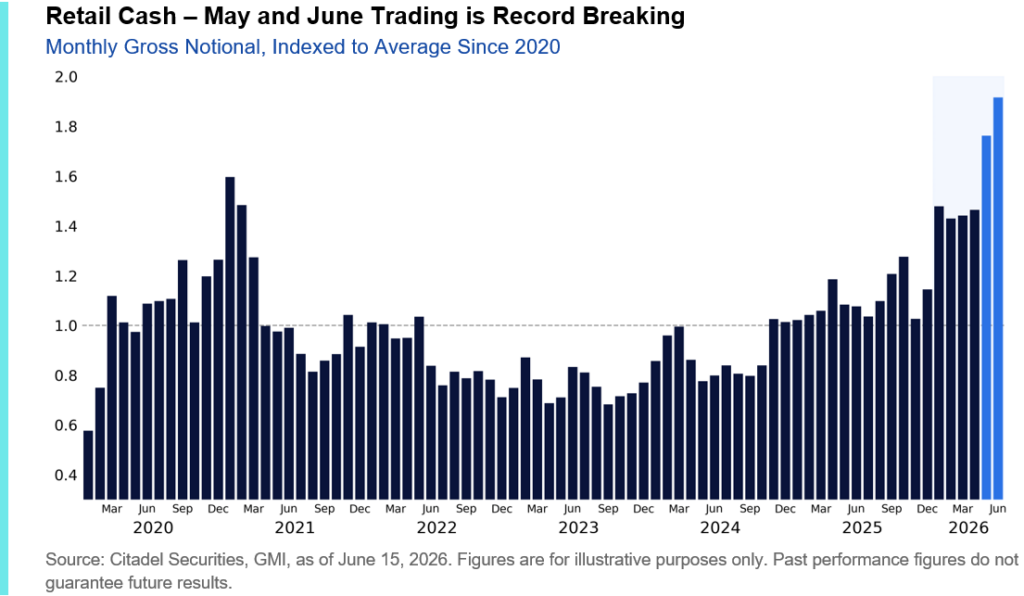
I want to give credit where it’s due. Scott Rubner, the chief equity and derivatives strategist at Citadel Securities, laid out the mechanical case in a note last week, and I agree with most of his map.1 Citadel sees about 35% of all US retail order flow, so when they describe positioning, I listen. The disagreement isn’t about the flows. It’s about what got armed underneath them on Wednesday afternoon.

Tweet of the Day
New UPDATED Trading Rules With Desktop Printout
“Want to achieve better long-term success in managing your portfolio? Here are our 15-trading rules for managing market risks.”
Please subscribe to the daily commentary to receive these updates every morning before the opening bell.
If you found this blog useful, please send it to someone else, share it on social media, or contact us to set up a meeting.