


Bill Dudley, a respected economist and President of the New York Fed during the Financial Crisis, penned a Bloomberg editorial outlining six challenges facing the Fed in 2026. Given his deep background in economics and intimate knowledge of the Fed, it’s worth providing a brief summary of his views.
Independence is at the top of the list of challenges facing the Fed as President Trump continues to appoint new members, including a new Chair in 2026. Will his appointees undermine public trust in the Fed’s independence, and if so, will it cause inflation expectations to become unhinged?
If President Trump manages to undermine faith in the Fed’s commitment to containing inflation, the repercussions could be disastrous.
- Interest Rate policy was a big challenge for the Fed in 2025, but may be less so this year as Dudley believes interest rates are at an equilibrium. Accordingly, he thinks there “should be less tension” between the Fed’s employment and inflation goals going forward.
- Balance Sheet: Dudley states that some Fed Chair candidates, likely including Warsh, oppose increasing the Fed’s balance sheet. Therefore, he warns that if the Fed were to reduce its asset holdings, they risk the challenging duo of “interest rate volatility and contagion risk within the banking system.”
- Bank Supervision: It is widely believed that the Fed will relax and streamline some capital regulations for banks. Can they do so without putting taxpayers and the economy at risk?
- Stablecoins: Will the Fed allow new crypto-related fintech firms to access Fed accounts? The answer to our question will “help determine the future of the US payments system.”
- Monetary Policy Framework: Dudley argues the Fed needs to reform its communications with the public. To wit:
Its quarterly summary of economic projections, for example, emphasizes the modal forecast and obscures what’s driving disagreements about the appropriate interest rate path — differences in economic outlook, or in how monetary policy should respond. A better approach would be to publish a staff forecast accompanied by alternative scenarios, similar to what the European Central Bank does. This would help market participants understand how the Fed would react if the economy deviated from the baseline forecast and thus make monetary policy more effective.
What To Watch Today
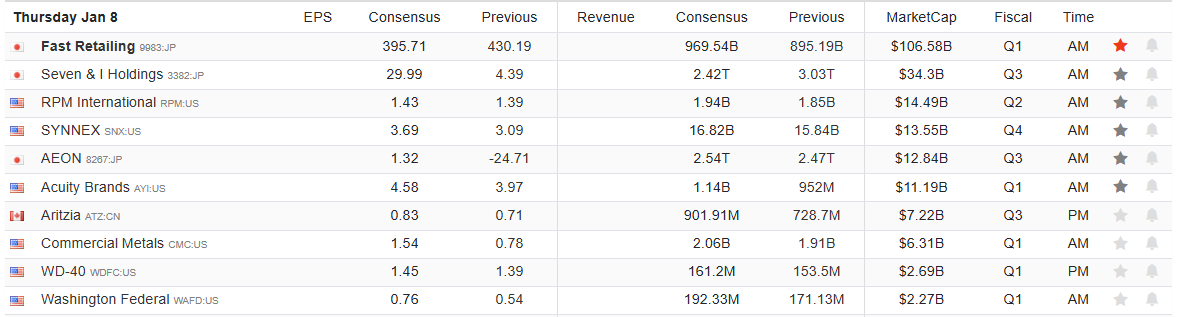
Earnings
Economy

Market Trading Update
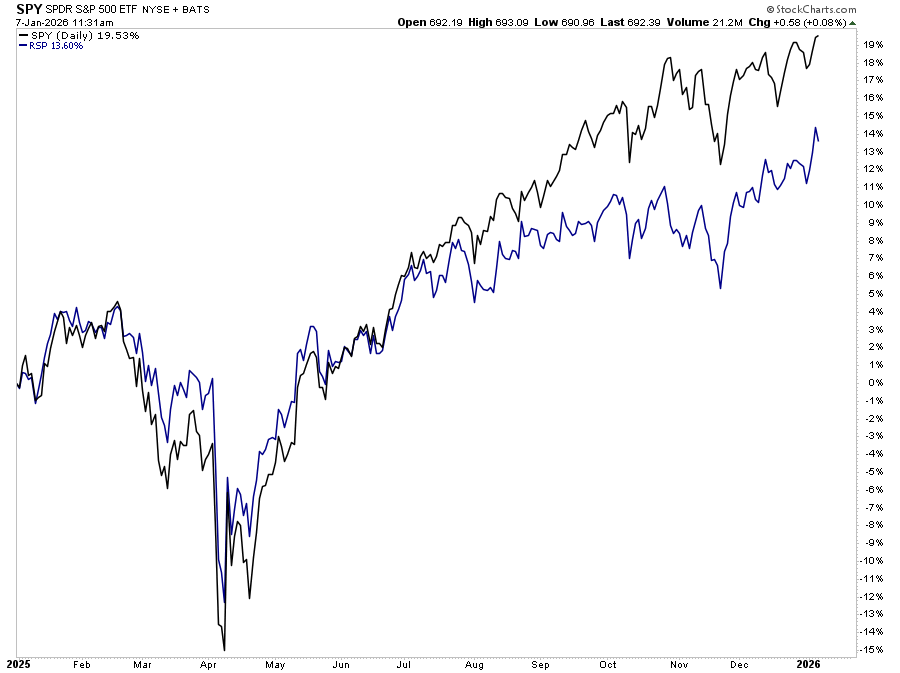
Yesterday, we touch a bit on sector rotation and the real return now offered in fixed income. From a market perspective, the set a new all-time high on Tuesday after holding support at the 20-day moving average. For now the bias remains bullish and market positioning continues to remain at elevated levels. Market breadth has also improved in recent weeks with the S&P 500 Equal Weight Index closing the performance gap somewhat to the S&P Market Cap Weighted index.
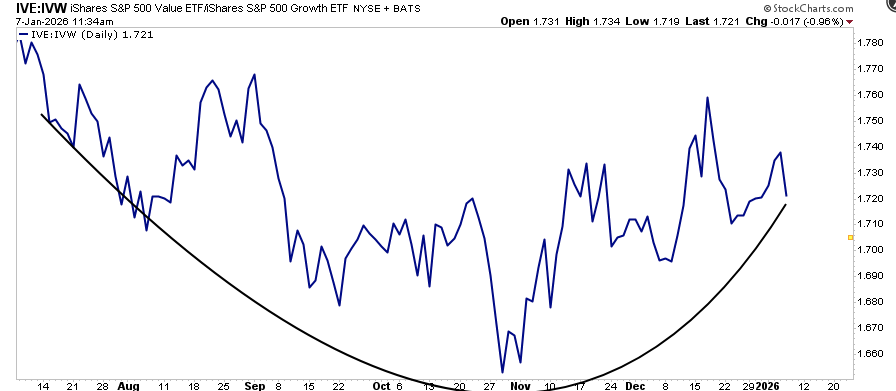
Furthermore, we have also seen an improvement between value and growth stocks, also suggesting a broadening of the market near term.
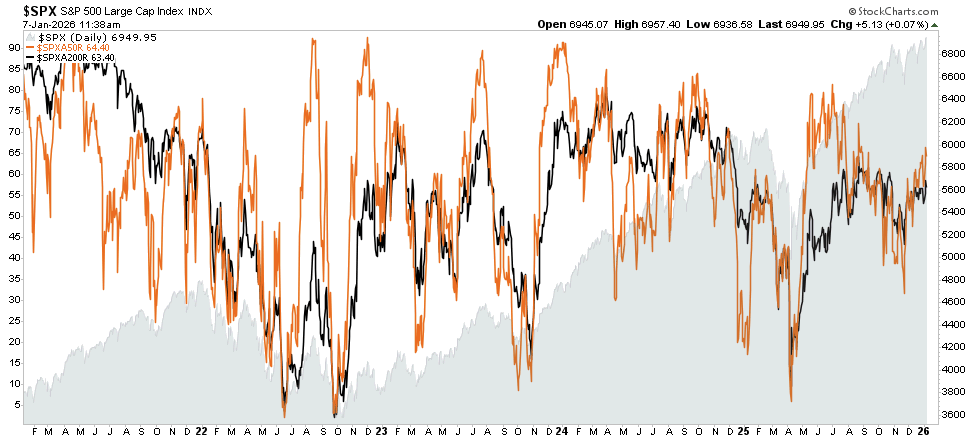
While these transitions suggests an improvement in overall breadth, the majority of beadth measures remain on the weaker side. As shown, the number of stocks trading above their respective 50- and 200-Day Moving Averages does not represent a strongly trending bull market.
With volatility suppressed and markets trading somewhat sloppily, it probably pays to continue to manage portfolio risk accordingly. While the Wall Street analysts are very bullish about 2026, that doesn’t mean that any further increases in performance will come without some bumps and bruises along the way.
Our concern going into 2026 is a function of both fundamentals concerns as well as technical. With the S&P 500 trading at the top-end of its long-term performance trend, reversions to the mean have been a common occurrence. Secondly, with the intial “sell signal” in place, we are closely watching the longer-term momentum signal. If it triggeres, such suggests a mroe cautiously stance with respect to equity allocations.
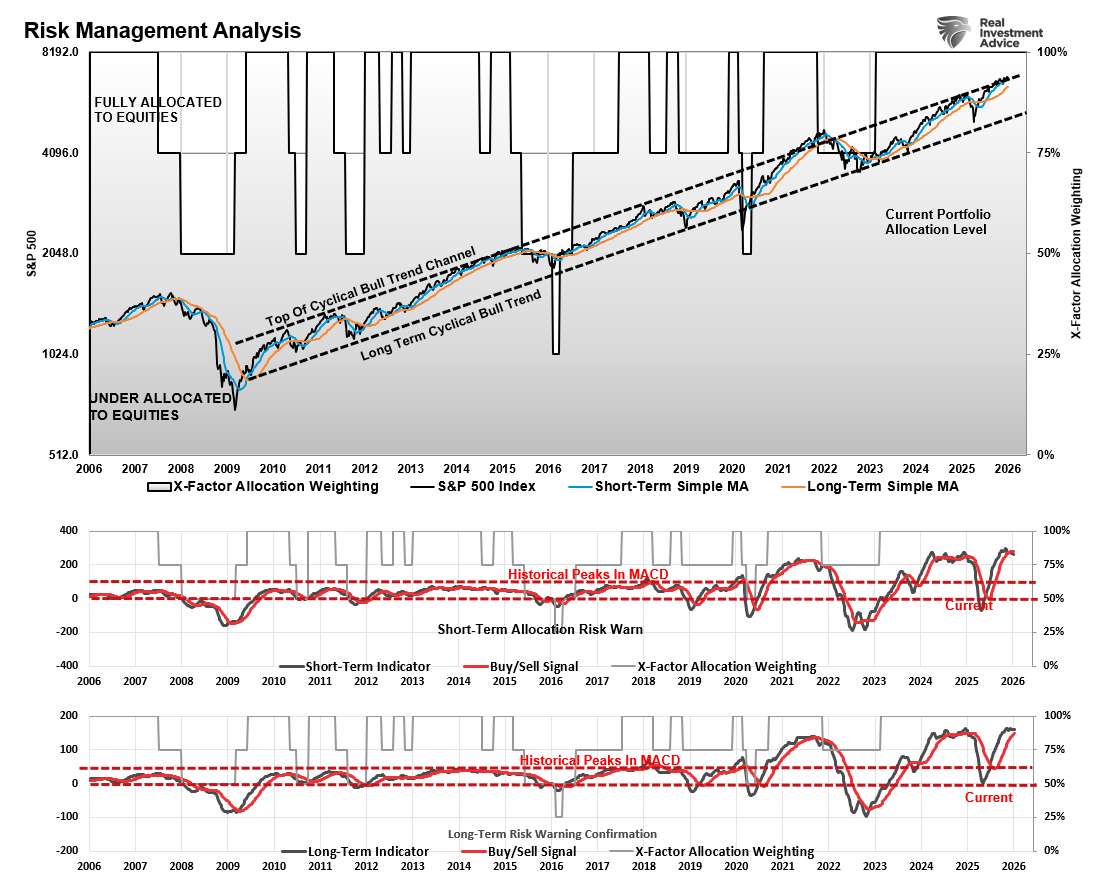
While the improvement in participation is certainly encouraging, the technical concerns are elevated. Is this time different? Maybe, but that is not an appropriate way to manage portfolio risk. We will continue monitoring the technical backdrop. If it begins to markedly deteriorate we will begin reducing risk aggresively.
Trade accordingly.

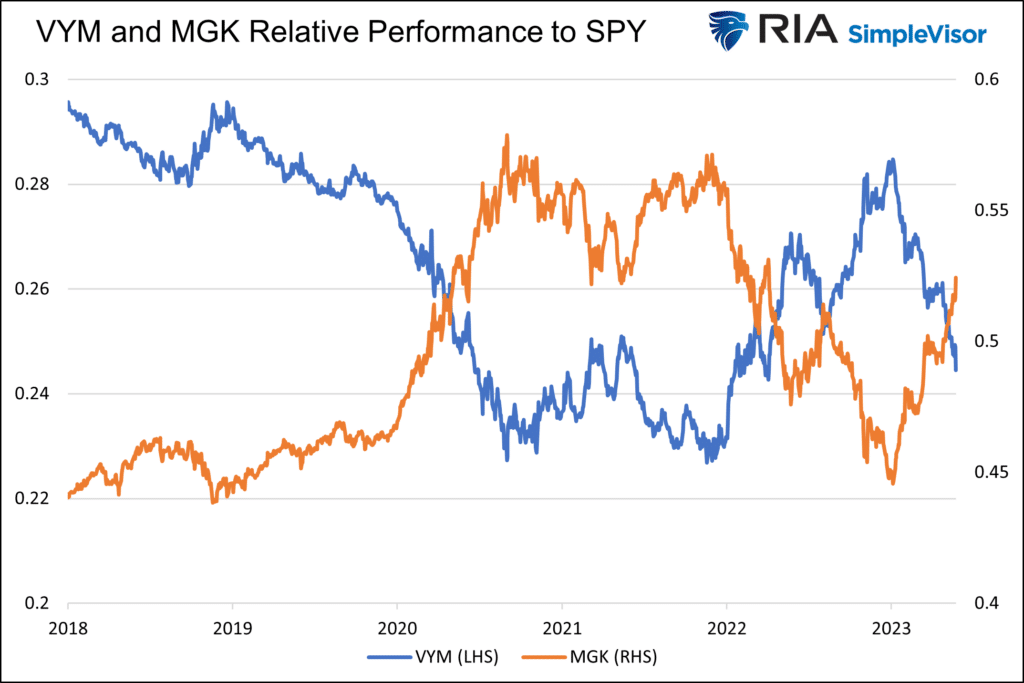
SimpleVisor’s New Core Factor Rotation Model
We launched a new SimpleVisor model on January 2nd called the Factor Rotation Model. Historically, the performance of value and growth factors relative to the S&P 500 exhibits a strong negative correlation. Michael Lebowitz provided an overview of this concept in his piece: Relative Rotation – Unlocking the Hidden Potential Part 1. While the article uses a simplified example, it highlights the philosophy behind our new Factor Rotation Model. The graph below from the article exemplifies our motivation for creating this model.
The model is fully allocated to equities, aiming to outperform the S&P 500 over the long term by strategically rotating between value and growth exposures. Trading signals are generated by our proprietary, rules-based quantitative model.
The model has two primary allocation states: overweight value/underweight growth or overweight growth/underweight value. The model targets an 80/20 allocation split between the two factors. Trading signals may persist for as little as one month or longer than one year. Given the possibility of high turnover, the model may not be appropriate for tax-sensitive individuals. The model may be rebalanced without a trading signal on occasion.
The current signal indicates an overweight in value; thus, we’ve allocated the model accordingly at launch.
The model has more inputs than our SimpleVisor absolute and relative factor analysis tool. However, the factor analysis tool is useful for assessing how the market shifts between growth and value.
2026 Forecast: ‘Tis The Season For Wild Guesses
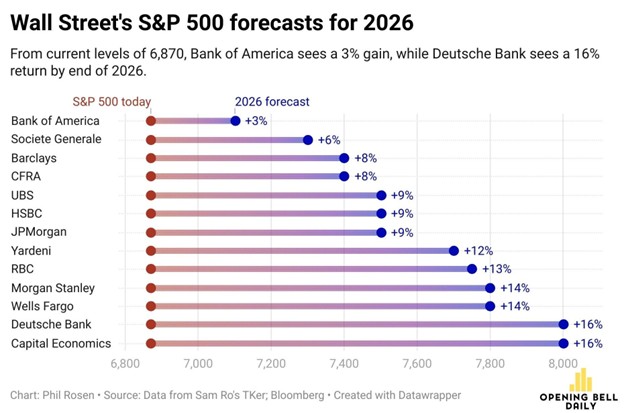
It’s that time of year when every Wall Street analyst posts their forecast for where the S&P 500 will close at the end of 2026. This year, as in every other, Wall Street expects the S&P 500 to post positive returns. As shown below, Bank of America is the most cautious, with a 3% gain, while Deutsche Bank and Capital Economics are the most bullish. On average, the analysts shown below forecast a 10.5% return in 2026, below last year’s 16% but slightly above the longer-term average.
Like Wall Street, we could spitball a 2026 price forecast for the S&P 500, but why? It’s a fruitless endeavor. No one has enough insight into the countless events that will unfold in 2026 and their potential economic, fiscal, and monetary consequences to make a meaningful forecast. Furthermore, even if we had a crystal ball that predicted how the year’s events would unfold, gauging their impact on investor sentiment and, ultimately, on markets would be nearly impossible.
Instead of offering a forecast for 2026, let us consider the potential events and factors that could influence investor sentiment and move markets this year. Inevitably, no matter how many events we and others are considering today, there will be market-moving ones that are not on anyone’s radar currently.
Tweet of the Day
“Want to achieve better long-term success in managing your portfolio? Here are our 15-trading rules for managing market risks.”
Please subscribe to the daily commentary to receive these updates every morning before the opening bell.
If you found this blog useful, please send it to someone else, share it on social media, or contact us to set up a meeting.