


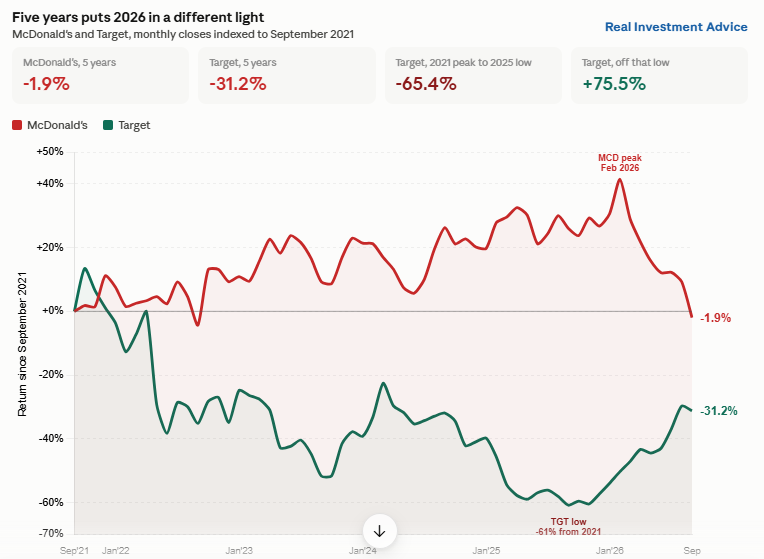
McDonald’s (MCD) hit four-year lows last week, down 22% on the year and 31% from its March high, marking a seventh straight weekly loss, its worst streak since 2014. Many investors look at a stock like MCD as a verdict on the American consumer. While its sales can be telling, internal issues are driving the bulk of the underperformance, not the macroeconomic environment.
McDonald’s raised prices until the brand stopped being “cheap.” It is now paying to win that “cheap” reputation back through $5 value meals and other reduced or restrained pricing. Management claims the pricing has left the US. company-operated margins at unacceptable levels. Despite their tactics, same-store sales grew a mere 0.8% last quarter, down from 2.5% a year earlier, while competitor Taco Bell posted a 7% increase. MCD’s downslide accelerated after the September 23 investor day, when management outlined $8.5 billion in franchisee support, or roughly $800,000 per store.
The rest of the consumer complex is mixed, which doesn’t confirm the macro story some believe MCD is sending. Nike is down 43.5% this year and nearly 80% since its late 2021 peak. This is due to increased competition and failures in branding and distribution. Meanwhile, Target is up 56.7% year to date, and Starbucks is roughly in line with the S&P 500.
Sector data points to broader economic weakness, with consumer discretionary stocks down 6.6% while the S&P is up 13.2% for the year, and staples trailing the market by about 8%. Yet, August retail sales rose 1.2%, the largest gain since March. Spending is rising while some of the stocks selling to consumers are falling. As evidenced by MCD’s and Nike’s woes, this performance divergence may be due more to changing consumer tastes than to economic constraints.
What To Watch Today
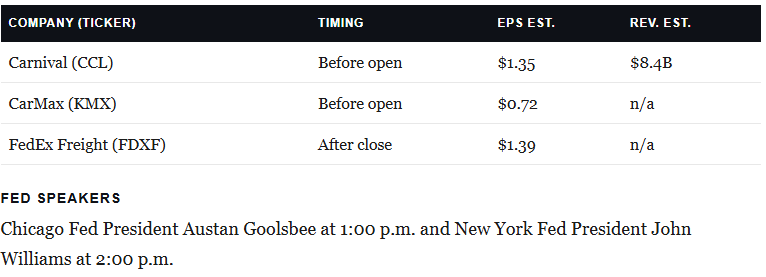
Earnings
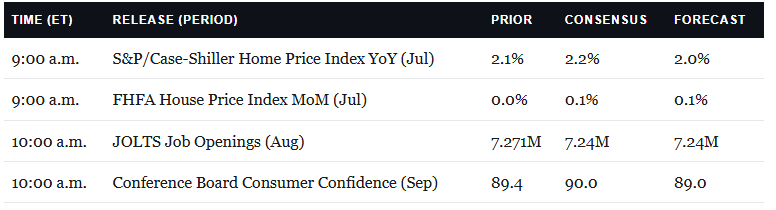
Economy
Market Trading Update
Yesterday, we noted the S&P 500’s MACD had triggered its first buy signal since August 3. The equal-weight index, however, lagged its cap-weighted cousin. Today, I want to revisit an old Wall Street adage that Ryan Detrick at Carson Group raised last week: “never short a dull market.” The index hasn’t posted a 1% daily decline in 37 trading days. It also just went four straight weeks without a 1% weekly move in either direction.
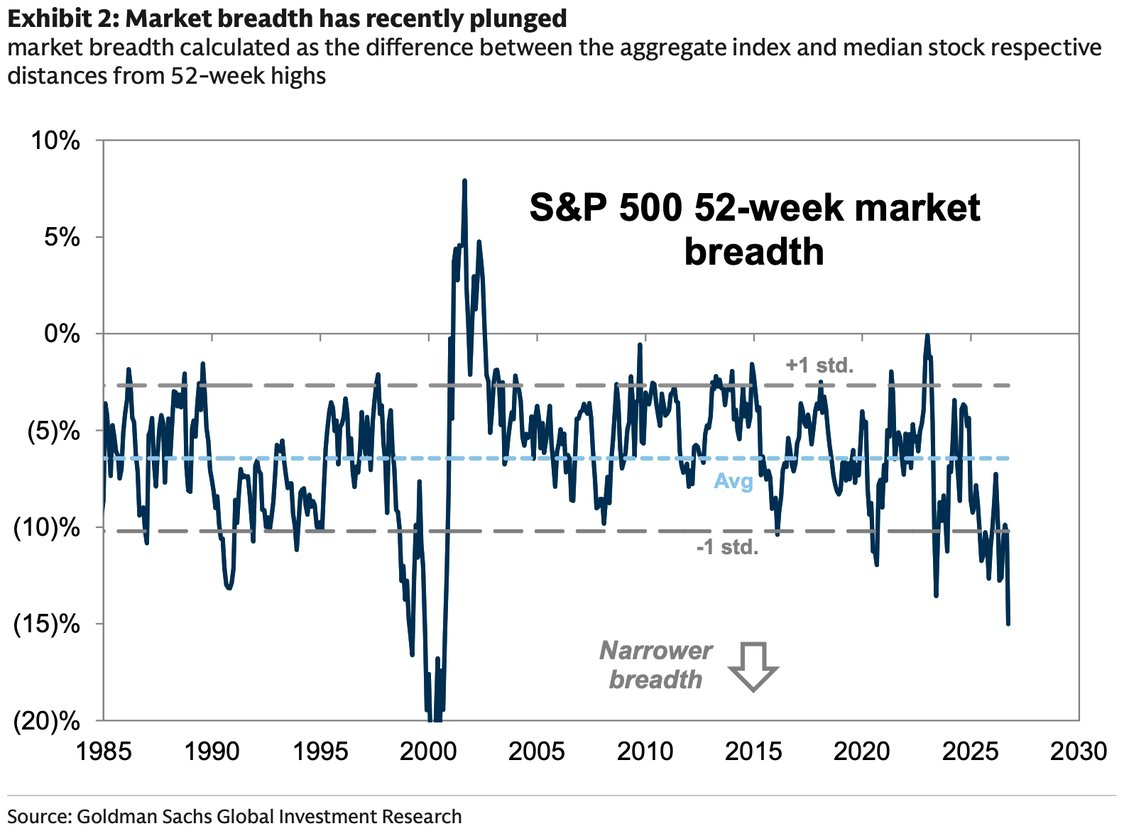
A quiet surface doesn’t mean calm underneath. Goldman Sachs measures breadth as the gap between the index and the median stock’s distance from its 52-week high. Notice in the chart below that the gap has plunged to roughly (15%), the narrowest reading since 2000.
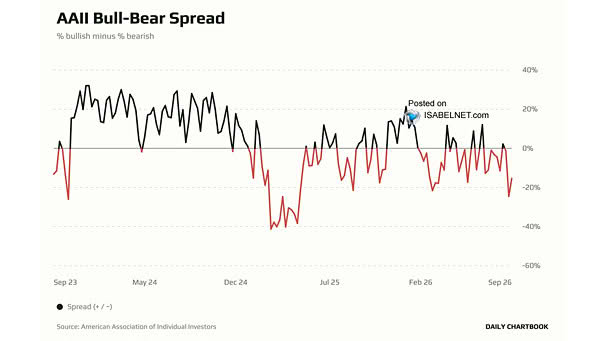
Investors have also noticed. The number of bearish investors in the AAII survey jumped 14% in a single week to the highest level since May 2025. That sent the bull-bear spread deep into negative territory.
Furthermore, retail investors are also piling into money market and cash-like ETFs. The 3-month pace of those flows has lined up with nearly every meaningful low since 2018.
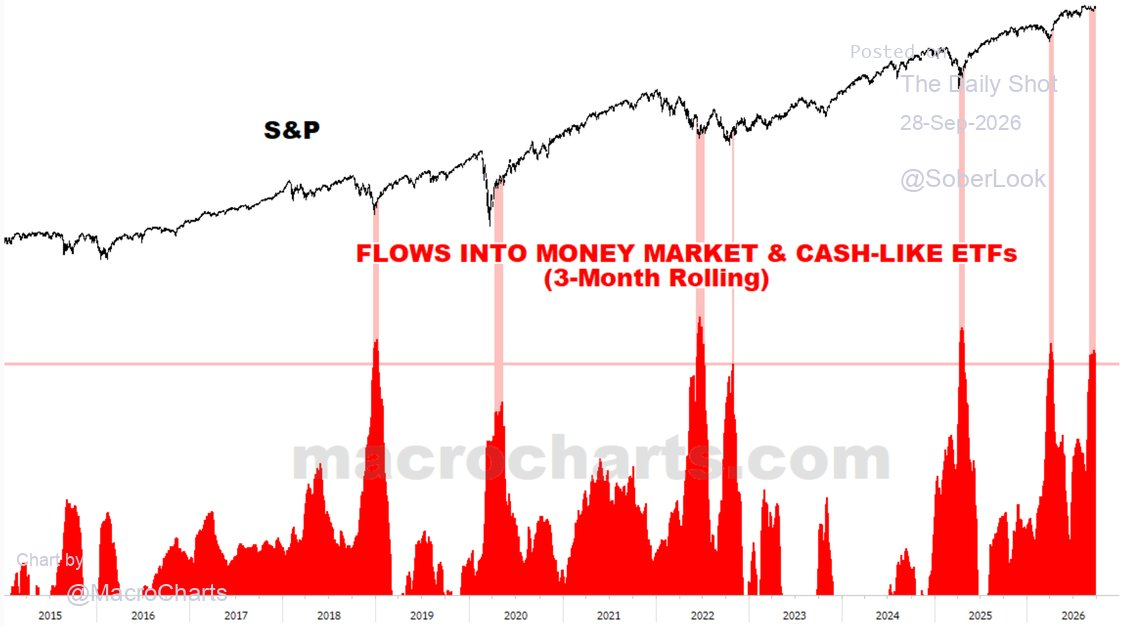
Here’s where it gets interesting. In 2018, 2020, 2022, and 2025, those cash surges arrived after the index had already fallen. This time, cash is piling up, with the S&P 500 just north of 7,740, about 2% of its high. Investors aren’t fleeing losses, but a “risk” they expect to show up. Such is the nature of sentiment at extremes. Interestingly, at extremes of bearish sentiment, flows, and breadth, such readings have historically been contrarian, as the market sets up for a rally.
That is the current setup. Weak breadth, risk-off flows, and bearish sentiment leave the median stock plenty of room to catch up. Most importantly, that bearish backdrop is doing the work of a correction without the price damage.
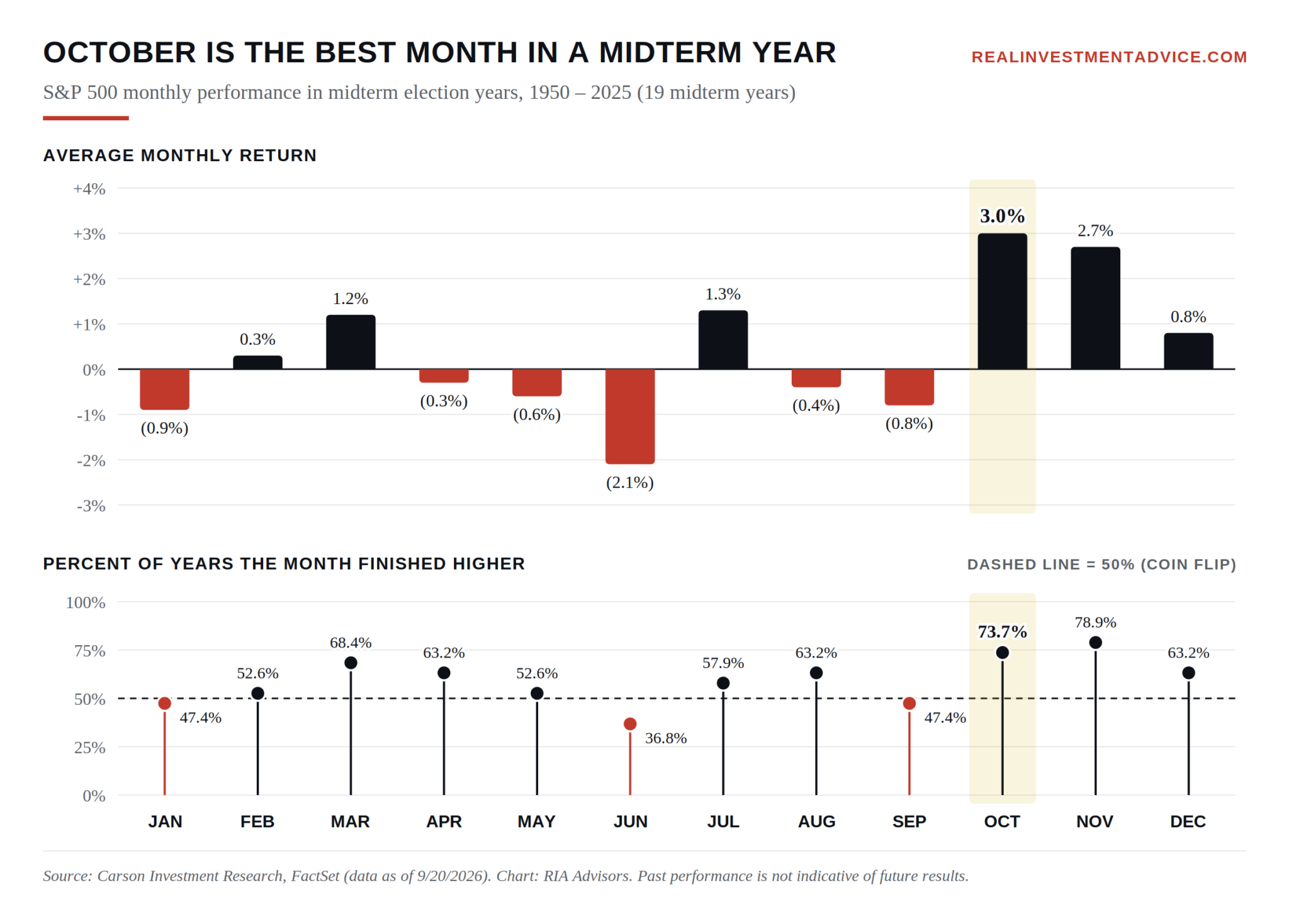
This is where seasonality adds a tailwind. Since 1950, October has been the best month of midterm years, averaging a 3.0% gain. It finished higher 73.7% of the time, with November close behind at 2.7%. Q3 earnings season will begin, corporate share buybacks will return, and oversold conditions could fuel a rally into year-end.
So, is now the time to be bearish? The data argues NOT, because bearishness is already the consensus trade, and sidelined cash is fuel for the next leg. That doesn’t mean chasing. Rebalance portfolios, and treat the 50-DMA near 7,636 as the risk line. A close below that level without improving breadth hands the argument to the bears, and we’ll reduce equity exposure as needed. However, with the crowd already braced for the fall, the risk is tilted to the upside.

The Haves and the Have-Nots
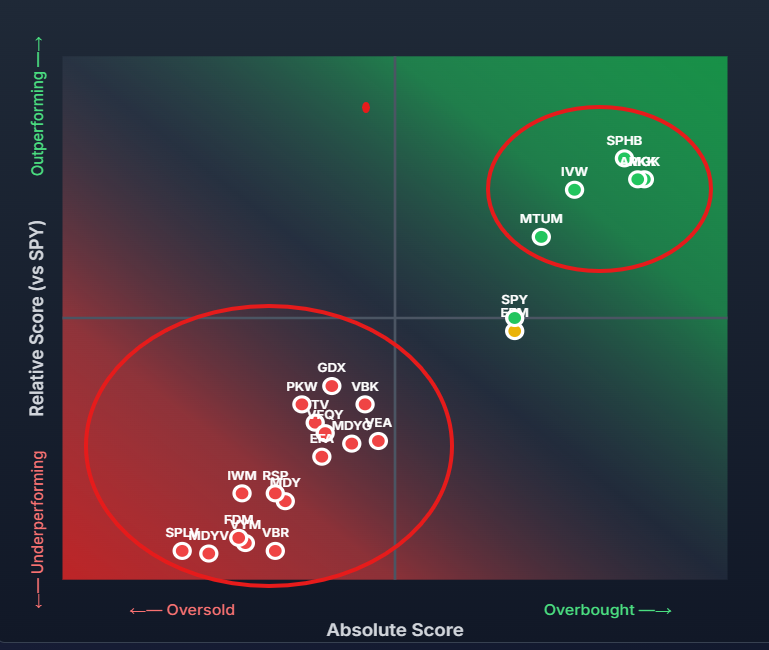
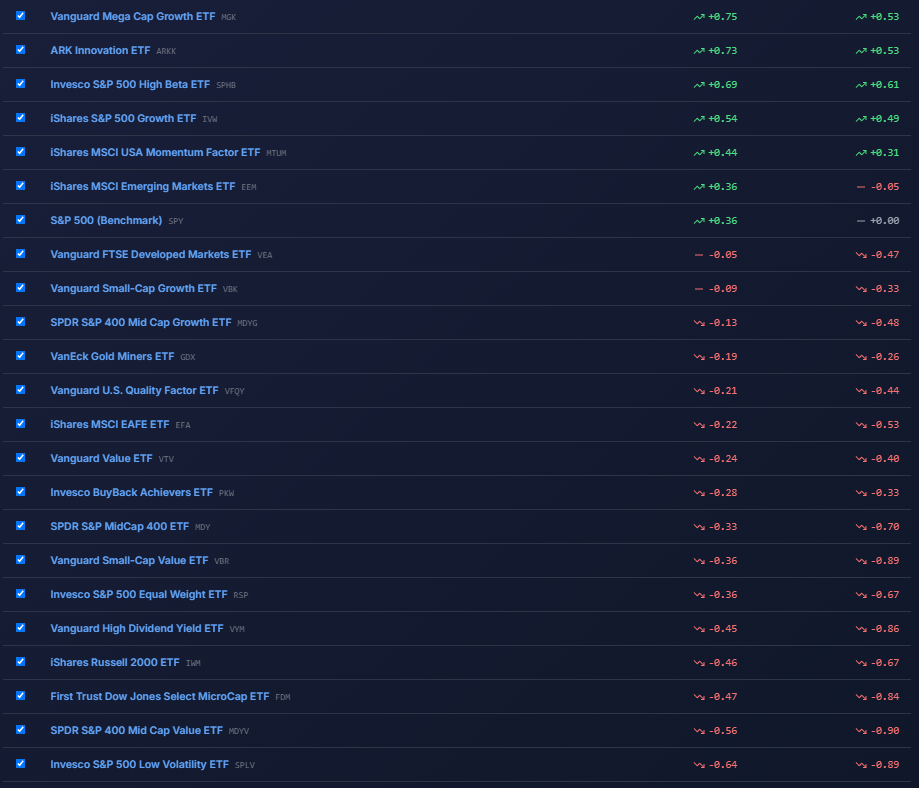
Over the past year, growth and value have had very similar returns. The S&P 500 Growth ETF (IVW) is up 19.5%, and the Vanguard Value ETF (VTV) is up 18.8%, while mega-cap growth (MGK) has trailed slightly at 16.8%. The performance split shown below in the graphic, indicated by the large gaps in absolute and relative scores, has been happening over the last few weeks. Over the last 60 days, MGK gained 6.2% and IVW 4.7%, against 1.6% for VTV and -0.4% for high-dividend yield (VYM).
The SimpleVisor technical scores in the second graphic show the gap more sharply. MGK, IVW, ARKK, momentum (MTUM), and high beta (SPHB) are the only factors scoring positive on both absolute and relative measures. VTV’s relative score is -0.40. The more defensive and cyclical value factors are much weaker. To wit, small-cap value (VBR) is -0.89, mid-cap value (MDYV) is -0.90, and low volatility (SPLV) is -0.89; all sit at extremely weak scores near the bottom of the range. The sector data points the same way. Technology is the only sector with a meaningfully positive relative score (+0.70), while eight of twelve sectors are below -0.30, and real estate and utilities are between -0.80 and -0.90.
Investor Optimism Wins As An Investment Strategy
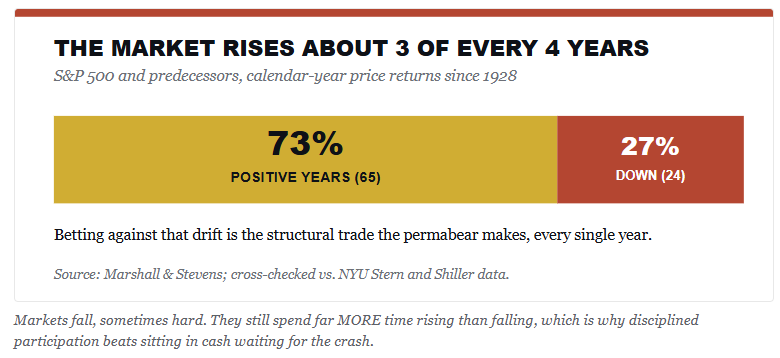
Hope is not an investment strategy. Every advisor has said some version of that line, and it holds up. You cannot pray for a higher portfolio. Ben Carlson made the sharper point in a previous piece that while “hope is not a strategy, investor optimism absolutely is.1″ I will take it a step further. Understanding why investor optimism wins over a full market cycle is one of the most underrated edges an investor can own, and it has almost nothing to do with waving pom-poms.
Look at the “wall of worry” investors have climbed in 2026. Inflation is sticky, with the headline rate back at 3.4% in August. The Federal Reserve is on hold and may raise rates rather than cut them. The ten-year Treasury yield sits near 4.8%. A summer scare over artificial intelligence dragged the Nasdaq to the edge of a correction.
Pick your headline of concern, and yet, the S&P 500 has closed at a record 27 times this year and trades up roughly 13% for 2026.2 So either the market is dangerously naive, or the permabears keep missing something structural. Having watched cycles since the late 1980s, I can tell you it is almost always the latter.

Tweet of the Day
Trading Rules With Desktop Printout
“Want to achieve better long-term success in managing your portfolio? Here are our 15-trading rules for managing market risks.”
Please subscribe to the daily commentary to receive these updates every morning before the opening bell.
If you found this blog useful, please send it to someone else, share it on social media, or contact us to set up a meeting.