


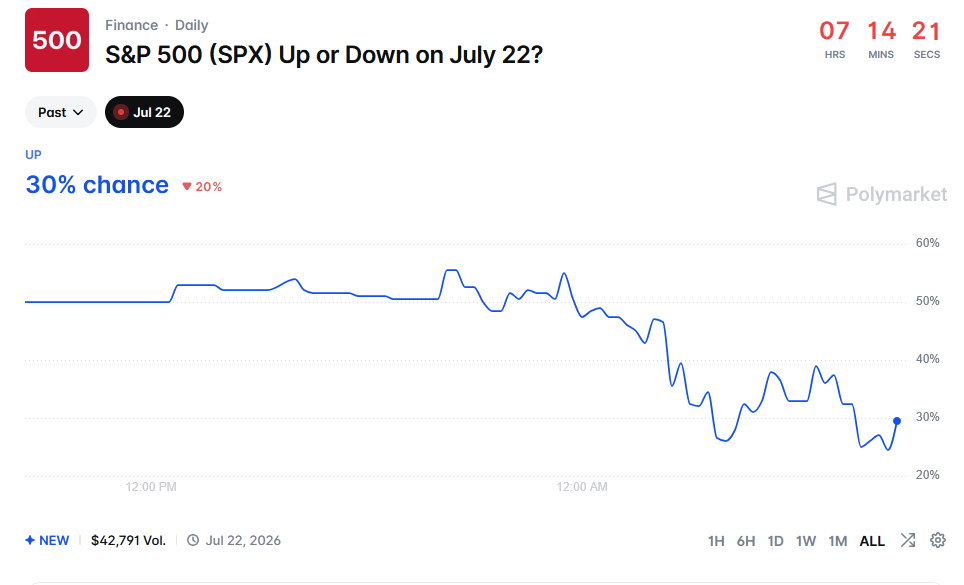
Prediction markets leader Polymarket has a daily contract that bets on whether the S&P 500 opens higher the next trading day. Yesterday’s contract, as shown below, implied just a 30% probability of an up open, despite the index gaining nearly 1% the day before. The prediction market proved correct with the market opening lower. That lack of follow-through between sentiment and prior day gain provides some clues about the mindset of some investors.
Prediction markets differ from most traditional sentiment tools in one important way: they reflect real money committing to an outcome. A consumer confidence survey merely captures opinions, which are often subject to heavy biases. Options skew, which does have real money behind it, can reflect positioning that is stale for days. A Polymarket contract resolving the next morning’s market direction reflects what traders believe now and, furthermore, it’s updated in real time as headlines break.
While prediction markets can provide clues, Benzinga notes that the trading volume on these daily up/down contracts has been fading. For instance, they note that only $20,156 changed hands on the July 21 bet. Per Benzinga, that was “one of the quietest prediction markets in weeks,” suggesting participation has cooled and reducing its value as a sentiment gauge.
Prediction markets are still new enough that their long-run reliability remains unproven. That said, the more sentiment tools in our toolbox, the better we can understand the collective market’s mindset.
What To Watch Today
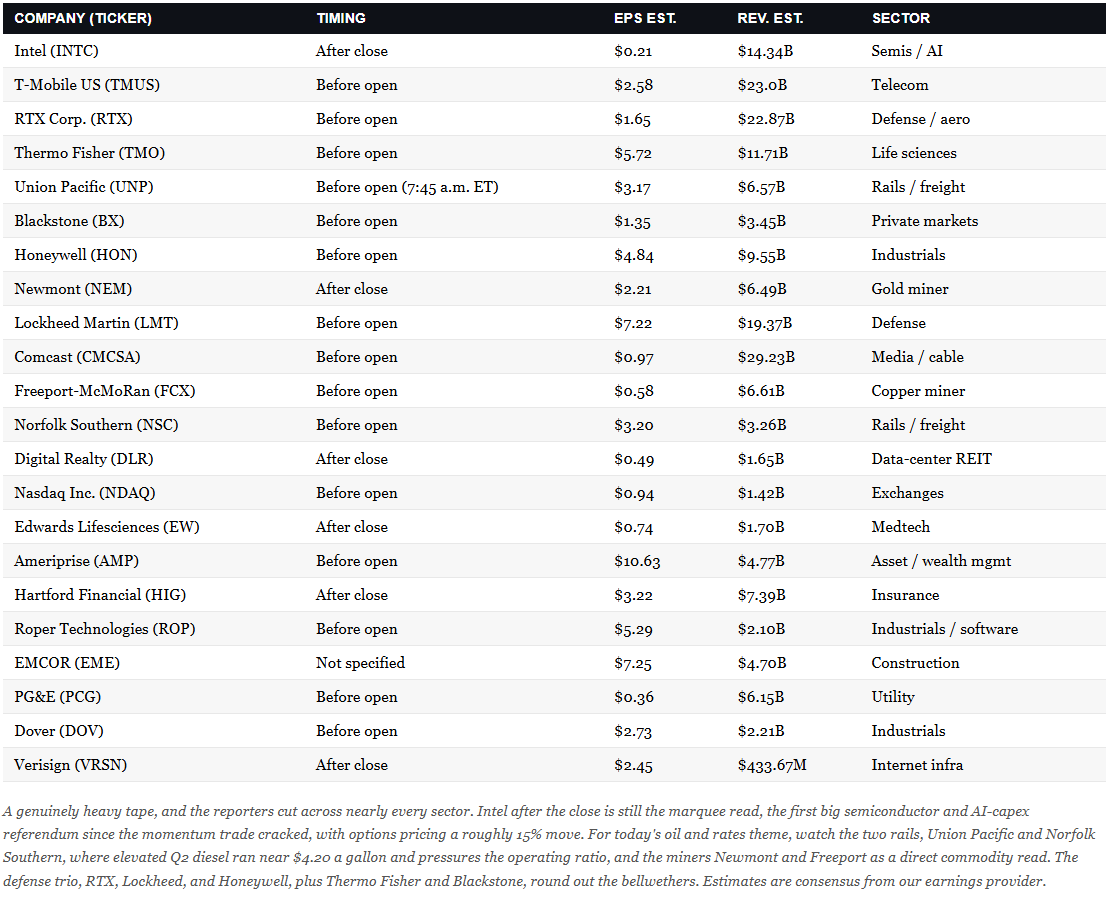
Earnings
Economy

Market Trading Update
In yesterday’s report, we walked through why oil and inflation move together, and what that link is doing to bond yields right now, linked here. Today, I want to push it one step further and ask the portfolio question. If the market believes oil heads lower over the next 18 months, is this the setup to start buying bonds?
Start with where we are. WTI trades near $86 a barrel this morning, Brent near $92, both up a fourth straight session as strikes on Iran and renewed Houthi threats to shipping keep a supply premium bid. Crude is up roughly 18% on the month. That move has not stayed in the pits. The 10-year yield sits at 4.60%, the 30-year at 5.11%, both firming right alongside oil.
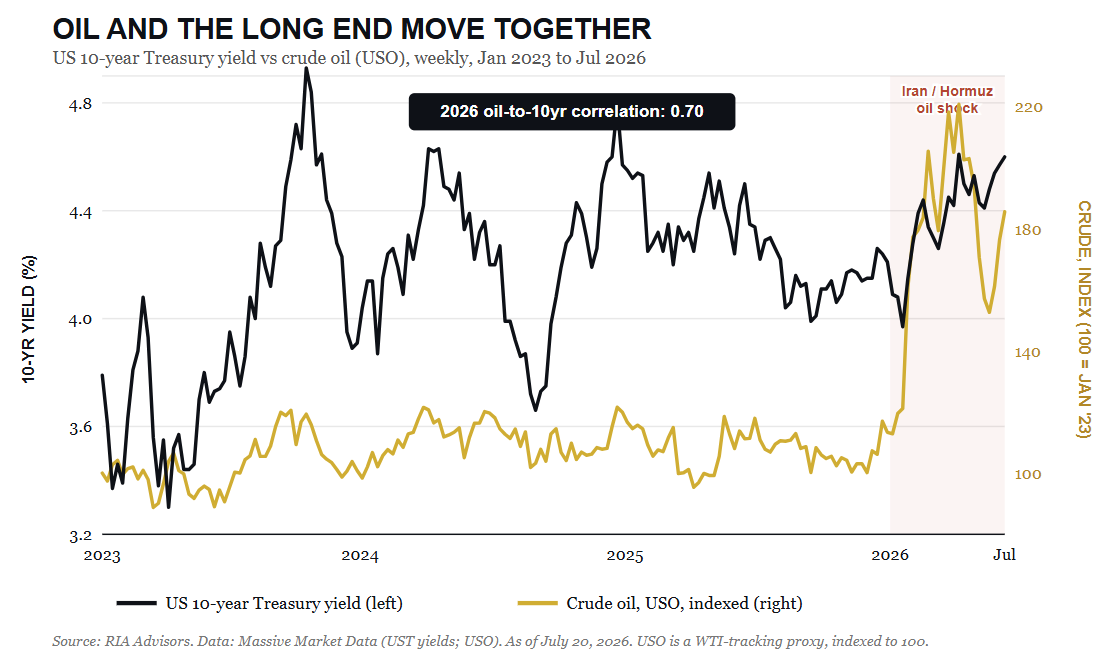
The reason is in the chart below. Through 2026, the correlation between crude and the 10-year yield runs 0.70 and 0.75 since the mid-February conflict escalation. This is NOT a coincidence. The recent backup in the long end is, in large part, an oil-driven inflation premium, not a growth story and not a fresh fiscal scare. Strip out the oil premium, and the underlying disinflation is intact. One-year market inflation expectations have fallen from 3.5% in May to 2.4% this month. Put plainly, the bond market is paying up for a barrel of oil right now, not for a hotter economy.
Here’s where it gets actionable. The forward curve and Goldman’s own scenarios tilt oil lower from here. As the chart below shows, Goldman’s base case drifts crude into the low $70s by 2028, and the downside case, higher production and softer demand, takes it toward $55. Only the upside case, a prolonged Hormuz disruption, pushes Brent back to $125 in 2027. Two of three paths point down. We flagged this same oil-leads-yields mechanic back in 2024 in “Why bond yields track the oil market.
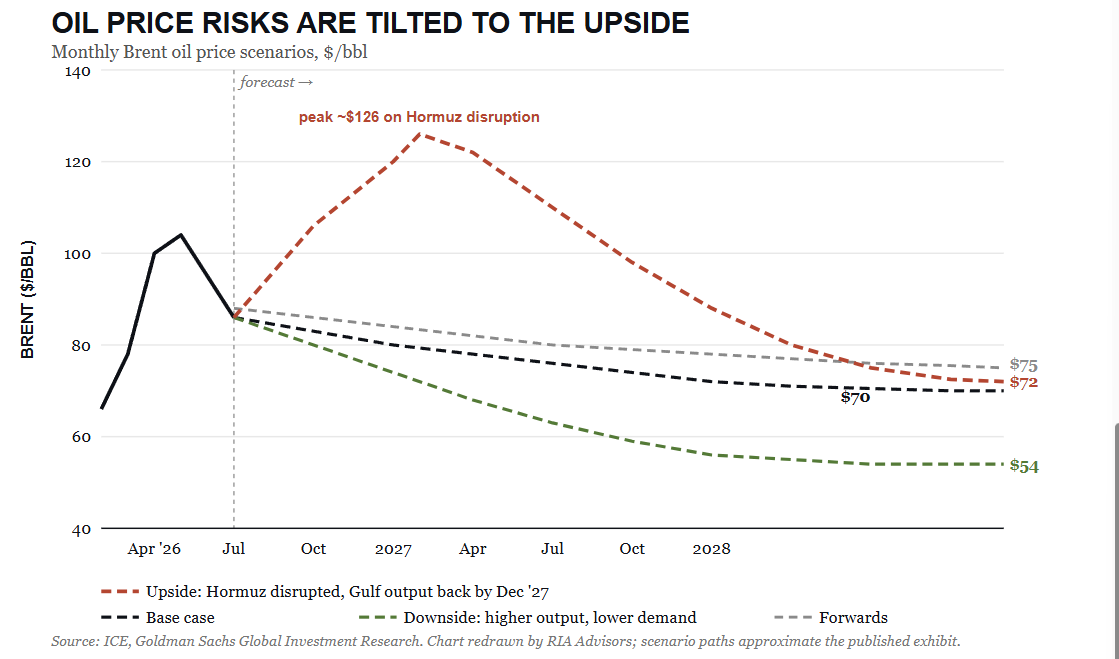
So is this the spot to buy bonds? If oil follows the base or downside path, the inflation premium bleeds out of the long end, yields fall, and duration bought at 4.60% pays off in both coupon and price. That is a real setup. BUT the upside oil tail is live, and a Hormuz shock would take yields higher before they roll over.
Until we know with some certainty, we are maintaining our shorter-duration positioning for now. If the Iran issue is resolved, we can then start laddering exposure to longer-duration holding rather than backing up the truck. If you have no bond exposure, you can buy the first tranche here, hold dry powder for a higher-yield entry if oil spikes, and let the base case play out. Trade accordingly.

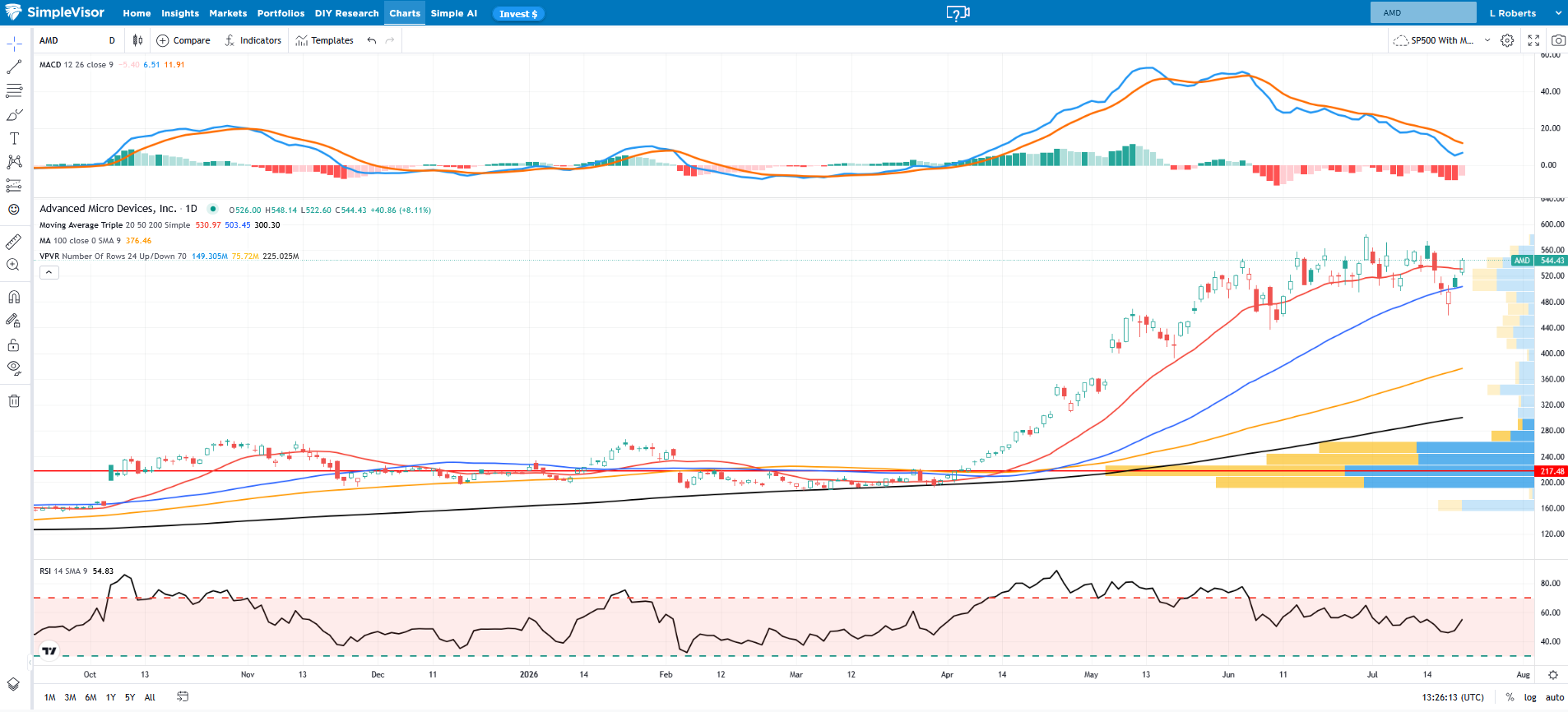
AMD And Anthropic Ink A Deal With A Circular Financing Wrinkle
Anthropic will buy as much as 2 gigawatts of AMD’s latest-generation Instinct MI450 chips beginning in the first half of 2027. This deal gives AMD an important customer in its battle to compete against Nvidia. AMD CEO Lisa Su told the Wall Street Journal,
We have very much wanted to be a major part of their infrastructure
The quote above is telling. AMD didn’t just win over a new client with a new product. Anthropic will not only receive the new chips starting in 2027, but AMD will also invest as much as $5 billion in Anthropic, with contingencies. Simply, that means AMD’s capital helps fund Anthropic’s purchase of AMD’s hardware. This is a circular arrangement where AMD’s investment underwrites the demand it books as revenue.
This is not a new pattern in the AI infrastructure buildout. Nvidia has structured similar vendor financing arrangements with its own customers. Circular financing raises an important question for investors: how much of the reported “demand” for AI chips reflects organic demand versus capital that chipmakers themselves are supplying to generate the orders. Circular financing arrangements, like the one between AMD and Anthropic, do not make the deal illegitimate; Anthropic needs the compute. But it does mean the revenue AMD books from this arrangement is not entirely arm’s length, and that distinction matters when evaluating the financial statements of involved companies.
Can SpaceX Fire On All Cylinders?
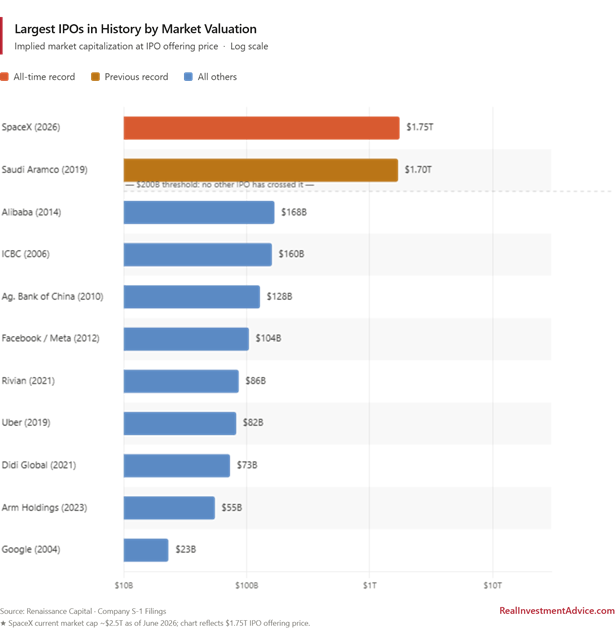
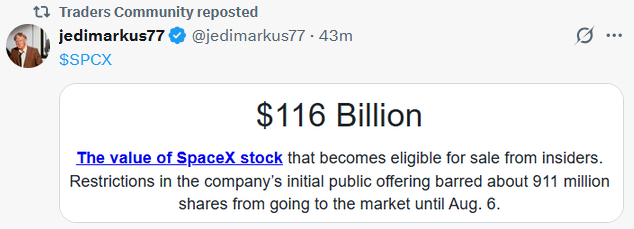
SpaceX’s June IPO was the largest in history, briefly pushing its market cap to $2.5 trillion before cooling to a still-staggering $1.84 trillion. But investors chasing the next Amazon need to ask a harder question: what growth rate does that price actually require? Using Amazon’s real trajectory as a benchmark, from its $438 million IPO valuation to today’s e-commerce and cloud dominance, we work backward from SpaceX’s current market cap to find the revenue growth needed to deliver a reasonable 20% annual return.
The answer is sobering. Depending on what multiple the market eventually assigns, SpaceX needs somewhere between 41% and 67% annualized revenue growth for the next ten straight years, a pace only a handful of companies have ever sustained, and one Amazon itself never matched at this scale. We also stack up Elon Musk’s own $1 trillion revenue forecast for 2030 against Wall Street’s far more conservative models from Morgan Stanley and Goldman Sachs.
SpaceX may well be an extraordinary company. Whether it’s an extraordinary investment at today’s price is a different question entirely; read the full breakdown to see the math for yourself.

Tweet of the Day
New UPDATED Trading Rules With Desktop Printout
“Want to achieve better long-term success in managing your portfolio? Here are our 15-trading rules for managing market risks.”
Please subscribe to the daily commentary to receive these updates every morning before the opening bell.
If you found this blog useful, please send it to someone else, share it on social media, or contact us to set up a meeting.