


“The Committee will deliver price stability.”
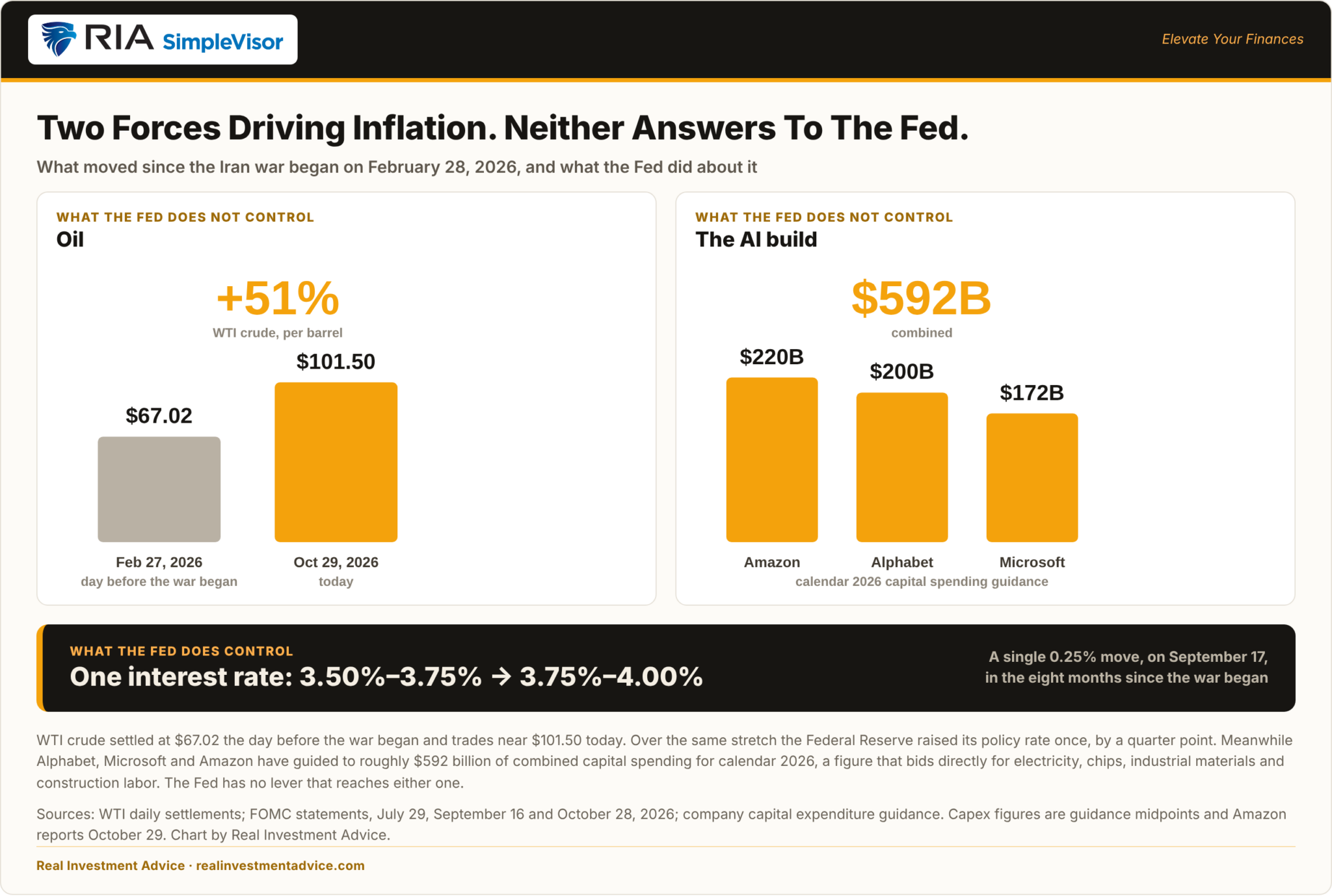
That promise has appeared in the FOMC statement in each of Warsh’s first three FOMC meetings. It deserves scrutiny because the Fed doesn’t usually make promises. Typically, the Fed Chair and FOMC describe economic and financial conditions and then state intentions. They tend to be shy about making promises because the Fed’s ability to impact prices and economic activity is limited. To wit, two of today’s biggest drivers of prices and economic growth are oil and AI-related capex spending.
Crude oil is over $100, up roughly 70% over the past year and 14% this month alone, due entirely to the war with Iran. The Fed can’t manage the war or reduce oil-related inflation. It said as much in July, when the FOMC statement attributed elevated inflation “in part” to “supply shocks that have driven price increases in certain sectors, including energy.” That sentence came out of the September FOMC statement.
Then there is the capital spending boom. Across Alphabet, Microsoft, and Amazon, calendar 2026 spending guidance approaches $600 billion, with Alphabet already signaling a significant increase in 2027. This is not only keeping GDP elevated but putting upward pressure on inflation.
The Fed controls the overnight interest rate. It does not control the Strait of Hormuz, and it does not decide whether a handful of companies spend $600 billion next year or $400 billion. The Fed may face breaking a promise, which does not bode well for the higher level of Fed credibility Warsh is trying to restore.
The statement instead should read “The Committee aims to deliver price stability.”
What To Watch Today
What To Watch Today
Earnings
Friday, October 30, 2026. The oil majors close out mega-cap week.
| Company (Ticker) | Timing | EPS Est. | Rev. Est. |
|---|---|---|---|
| ExxonMobil (XOM) | Before open | $4.03 | $104.4B |
| Chevron (CVX) | Before open | $4.83 | $60.7B |
| AbbVie (ABBV) | Before open | $3.77 | $17.3B |
Source: Yahoo Finance consensus EPS. Revenue consensus from Tiger Brokers, 24/7 Wall St. and Hudson Labs previews. As of October 29, 2026.
Economy
Friday, October 30, 2026. Wage costs and the last session of October. All times ET.
| Time (ET) | Release (Period) | Prior | Consensus | Forecast |
|---|---|---|---|---|
| 8:30 AM | Employment Cost Index QoQ (Q3) | 0.9% | 0.8% | 0.7% |
| 8:30 AM | ECI Wages QoQ (Q3) | 0.9% | n/a | 0.8% |
| 9:45 AM | Chicago PMI (Oct) | 58.8 | 56.1 | 56.0 |
Fed speakers: St. Louis Fed President Alberto Musalem speaks at 12:30 p.m. ET, the first Fed remarks since Wednesday’s decision to hold rates steady. Friday is also the last trading day of October, so expect month-end rebalancing flows into the close.
Source: Trading Economics (primary), confirmed against the BLS release schedule. As of October 29, 2026.
Market Trading Update
Yesterday, we argued for trimming value and adding to beaten-down tech in thirds, with cash-rich platforms like Alphabet at the front of the line. The Alphabet earnings selloff on Thursday tests that view. Shares opened at $286.88, down nearly 12% and on pace for the worst day since March 2020.
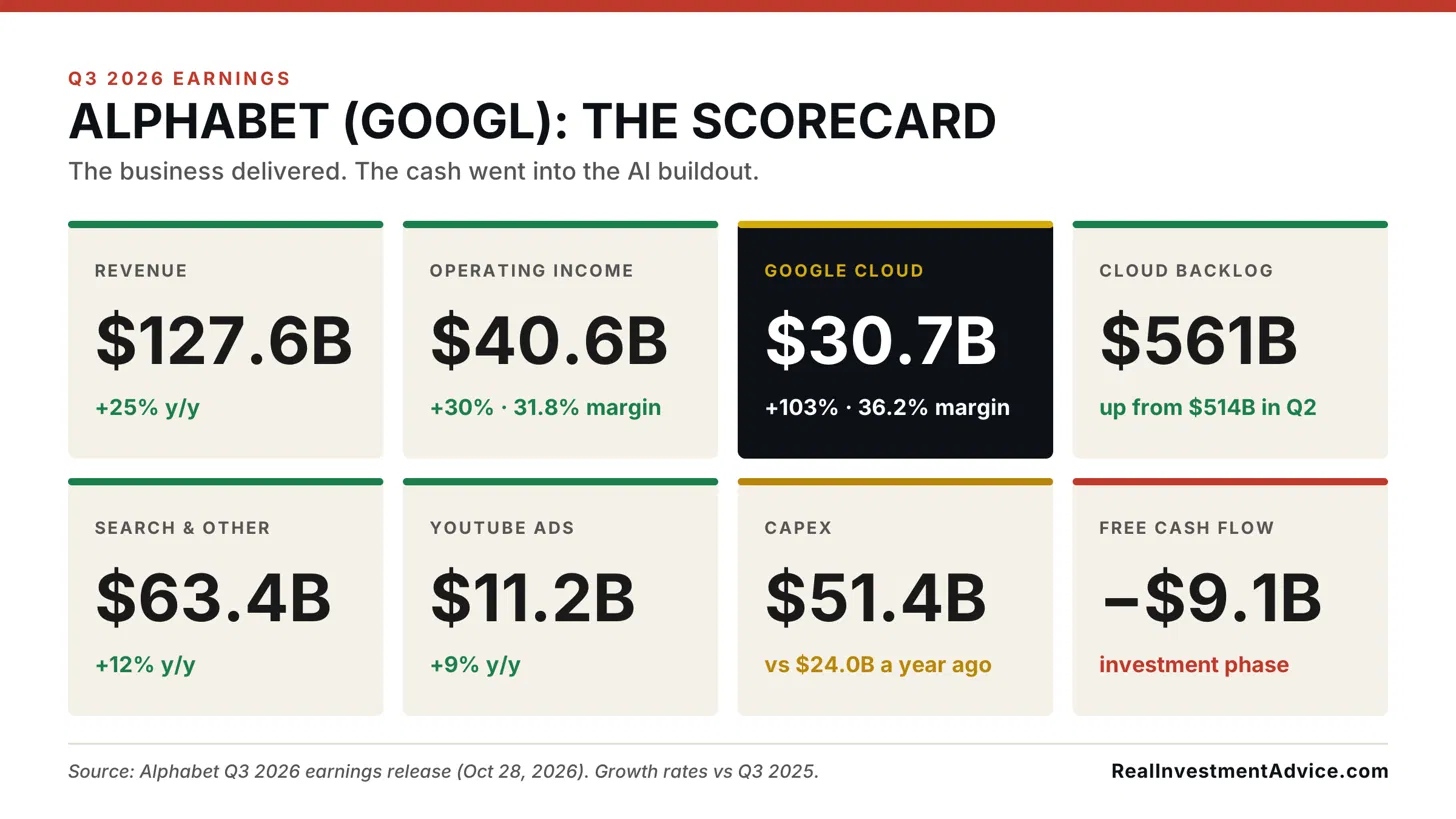
Start with what went right. Google Cloud revenue doubled to $30.7 billion, and its operating margin jumped to 36% from 24% a year ago. The cloud backlog grew to $561 billion. The GAAP earnings miss, $2.12 versus $3.01 expected, was driven largely by an $8.7 billion paper loss on equity holdings. That’s an accounting mark, not a broken business.
The tape agrees the selling is extreme. Notice in the chart below that the stock sits 3 standard deviations below its 20-day mean with RSI at 23. The only other reading under 25 in the past two years came at the March 30 closing low of $273.50. From there, the stock rallied 47% into May.
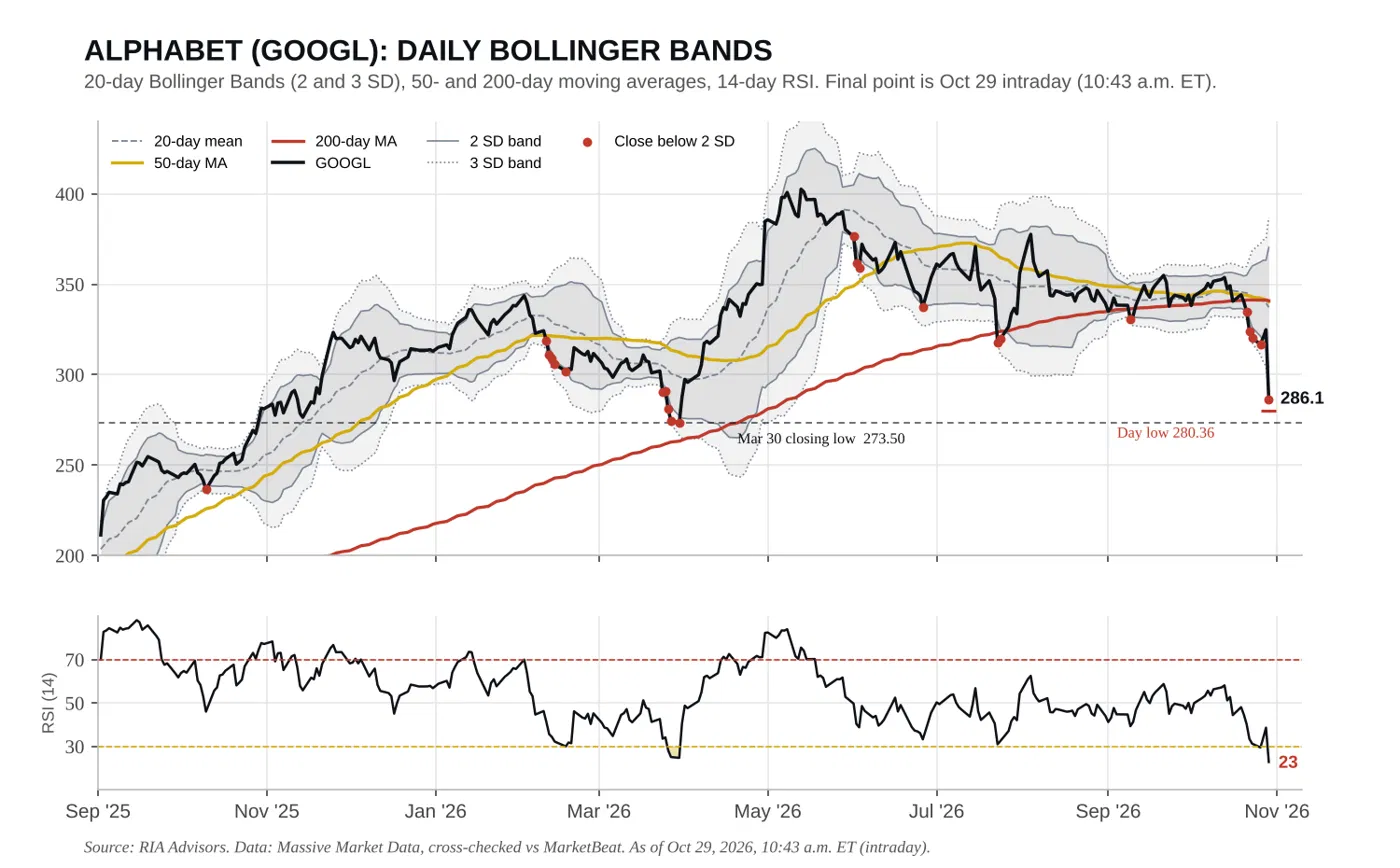
The opening hour shows where buyers and sellers are meeting. Sellers pushed the stock to $280.36 in the first ten minutes. Buyers absorbed it there, and by 10:40 a.m. ET shares were back near $286, above the session’s volume-weighted average price of about $284. Roughly 40 million shares traded in the first 70 minutes, already more than a typical full day. That’s capitulation volume, and so far the dip is being bought.
So what spooked the market? Cash. Capex hit $51.4 billion in the quarter, and management expects spending to rise “significantly” in 2027. Free cash flow turned negative, at $9.1 billion. Buybacks went to zero, while Alphabet raised $29 billion of debt and issued $12.4 billion of new stock.

That’s an investment phase, not an operating problem. As we wrote in AI Capex Depreciation Risk Is The Catch To Record Earnings, negative free cash flow is the temporary cost of building future capacity. Alphabet’s $42.3 billion of operating cash flow still covered 82% of the quarter’s capex. It holds $265 billion in cash and securities. That’s a world apart from the neoclouds borrowing just to stay in the race. The real catch comes later, when depreciation on all that equipment starts flowing through reported earnings.
Bob Farrell’s Rule #8 reminds us that sharp declines usually bring a reflexive rebound first, and a 3-sigma flush is where those rebounds start. The risk is a retest of the lows before the “buildout” story wins back the benefit of the doubt. With the 50-day average now rolling under the 200-day, the trend argues for patience.
If you put the first third to work this week, hold it. Do NOT add the second third yet. Today’s $280 low is the first line buyers must defend. We want a close back above $317, the October 26 low that held before earnings, before committing more. A close below $273.50 ends the trade.
Such is the nature of an investment phase. The business can be fine for months before the stock agrees.
Alphabet Ad Revenue In Question
For two years, one of the biggest bear cases on Alphabet has been that chat assistants, like its Gemini, would pull users away from its traditional Google search engine, possibly reducing advertising revenue. Wednesday’s earnings give that thesis nothing to work with.
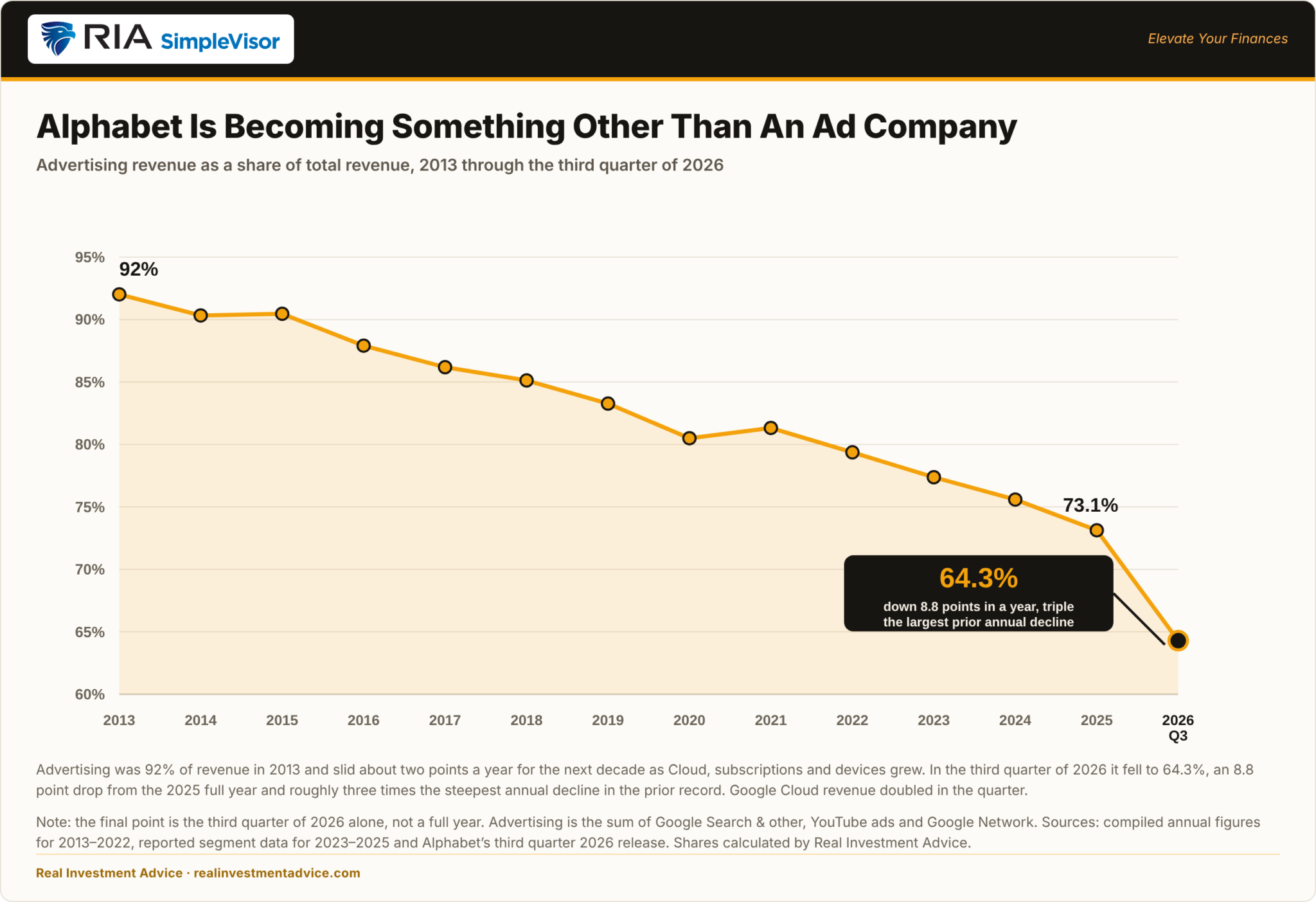
Google Search and other revenue rose 12% to $63.35 billion. YouTube ads grew 9% to $11.21 billion. Google Network, its third-party publisher business, grew 1% to $7.46 billion. Total advertising came to $82.0 billion, up 10.5% from a year ago.
In total, Alphabet grew 25% in the quarter. Advertising accounted for 10.5% of that. Of the $25.3 billion of additional revenue the company produced versus last year, advertising contributed nearly a third. The rest came from Cloud services.
Alphabet is no longer primarily an advertising company and has diversified its revenue significantly. Diversification is good. Going forward, the question for bulls and bears is not how the revenue will be split between advertising and other services, but what the total bottom line will look like in a few years, when AI is much more developed.

Tweet of the Day
Trading Rules With Desktop Printout
“Want to achieve better long-term success in managing your portfolio? Here are our 15-trading rules for managing market risks.”
Please subscribe to the daily commentary to receive these updates every morning before the opening bell.
If you found this blog useful, please send it to someone else, share it on social media, or contact us to set up a meeting.