


Bloomberg writes: “Iran War Oil ShockThreatens to Unleash Wave of Global Inflation.” To be fair, the article is not as pessimistic as the title suggests. However, the fear that significantly higher, sustained oil prices will unleash a wave of inflation is gaining popularity and merits discussion.
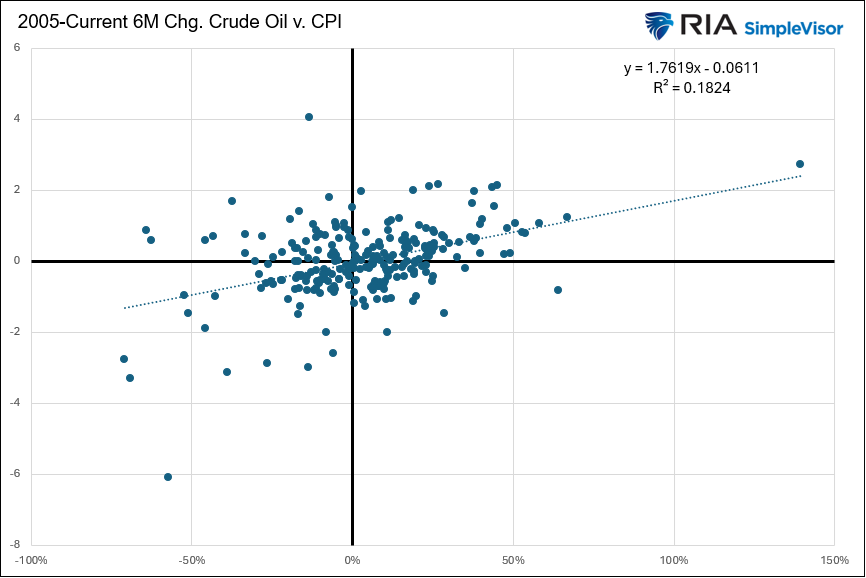
We start with math to address the historical relationship between oil prices and inflation. The graph below, using data since 2005, plots six-month percentage changes in oil prices on the X-axis against six-month percentage changes in the CPI on the Y-axis. Visually, you can see a positive correlation; however, statistically, the relationship is not strong, with an R-squared of only 0.1824. Based on this fleeting relationship, for every 10% increase in oil prices over six months, we should expect the monthly CPI to increase by 0.11, or about 1.38% on an annualized basis.
From an economic perspective its important to appreciate that oil price spikes often act as a tax on consumers. When households spend more filling their gas tanks or paying higher utility bills, they necessarily have less disposable income to spend on other goods and services. As a result, many corporations and businesses see weakening demand for their products, which tends to push prices lower elsewhere in the economy. In other words, while gasoline may temporarily boost headline CPI, it simultaneously suppresses price pressures in large portions of the consumer economy.
Lastly its worth noting that the Fed often looks through temporary, non-economic fluctuations in oil prices. To wit, they often stress the value of core inflation data. Core, by definition, excludes energy and food prices.
What To Watch Today
Earnings
- No notable earnings releases today
Economy

Market Trading Update
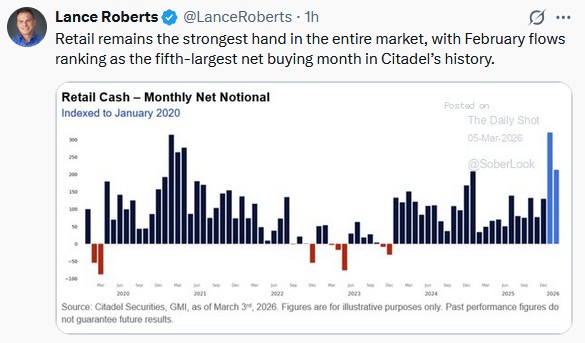
Yesterday’s discussion focused on market volatility and the very narrow trading range this year. It was also interesting to see the buyers step in and boost the market back above broken support on Wednesday. As we discussed previously, the retail buyer remains key.
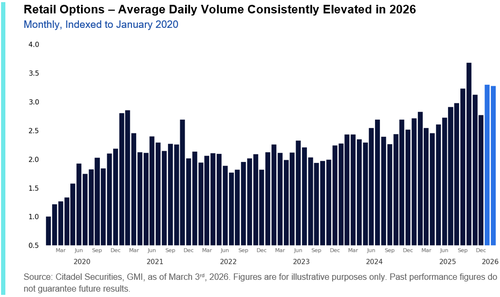
Since 2020, retail investors have become one of the most persistent forces in today’s market, consistently stepping in to buy dips at an increasingly elevated pace. Recent data from Citadel Securities and order flow analytics continue to show that individual investors treat every pullback as an opportunity. However, not only are they deploying capital rapidly into both individual equities and broad index funds whenever prices retreat, but they are also taking on speculative risk through options.
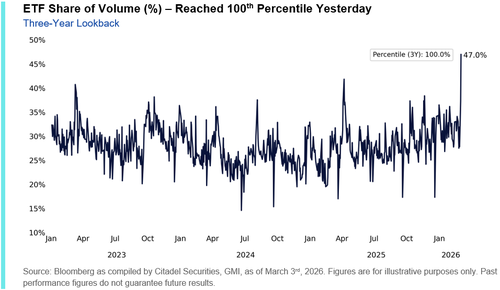
For example, since the military operation in Iran began on Monday, ETF share volume has surged. This is despite the media and “fear mongers” stating that the market was going to crash.
Furthermore, under the hood, the lightest SPX sectors have led, while the heaviest few sectors have lagged, resulting in the index having moved only -42bps YTD.
“In fact, beneath the surface, the distribution of constituent returns is increasingly right skewed this year, with the number of single stocks posting outsized gains this early in the year very elevated relative to history. Yet these moves are occurring in names with smaller index weights, limiting their contribution to headline performance.” – Citadel Securities
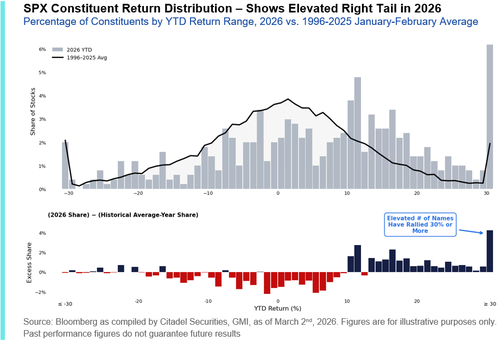
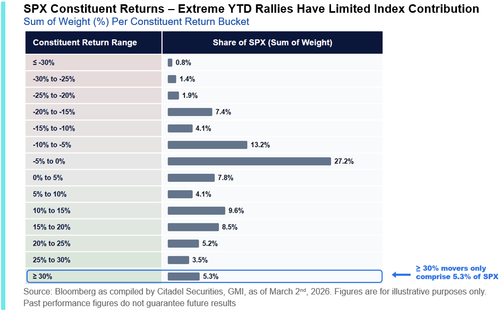
The important takeaway is that the market can not meaningfully rally without Technology, Financials, and Health Care leading the way. Furthermore, what makes the current environment particularly notable is the degree of speculative risk retail buyers are assuming. Leveraged ETF products and short-dated options have become favored instruments, amplifying both potential returns and potential losses.
The implications of this dynamic deserve careful attention. While persistent retail buying has provided a floor for markets during recent corrections, it also creates fragility. Leveraged and options-heavy positioning is inherently unstable, and a sustained decline that outlasts retail conviction could trigger forced liquidations, margin calls, and a rapid unwinding of speculative positions. Rather than cushioning a downturn, these concentrated bets risk accelerating it. The very behavior that has supported markets on the way up could become the accelerant on the way down, turning an orderly correction into something more disruptive.
As Citadel concluded:
“Despite geopolitical escalation in Iran, accelerating AI-disruption headlines, and renewed private credit concerns, the index remains confined within a narrow corridor. Defensive positioning, thin liquidity, and a concentrated call wall near S&P 500 7,000, alongside elevated downside hedging, have mechanically constrained movement. This is a technical market until we get to the March expiration. We take off our tactical bearish call and see scope for a bounce into mid-month, with volatility normalization acting as a catalyst. Expect chop into OpEx and greater flexibility thereafter, with April offering a more durable re-risking window.”
Trade accordingly.

Put Protection Can Be Bullish Fodder
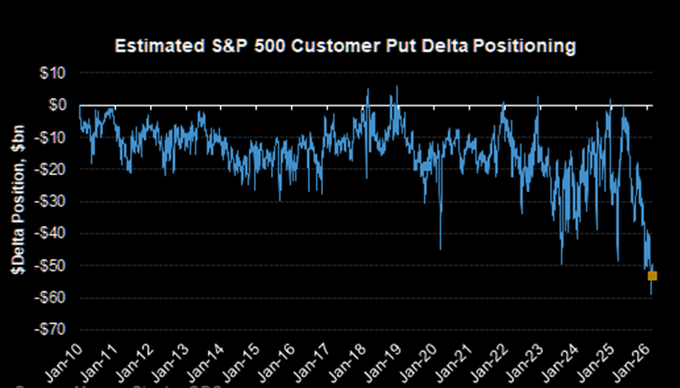
Record negative delta put positioning, as is the case in the options market shown below, is a reliable sentiment signal. When traders and investors accumulate puts at this scale, it reflects a widespread desire to hedge against, or bet on, a significant market decline. While it may seem worrisome that there are record bets against the market, the contrarian take is actually positive.
Historically, record negative delta put positioning has tended to coincide with market bottoms rather than the beginning of sustained declines, because it signals that fear is already fully priced into the options market. When everyone who wants protection has already bought it, the marginal seller of puts becomes scarce, premiums become expensive, and the incremental pressure from new hedging activity diminishes. Moreover, when the trades are reversed, they are bullish fodder for the market. In today’s case, if the Iranian situation de-escalates and/or is less severe than expected, the unwinding of that put positioning can become fuel for a sharp rally, as dealers who sold those puts must buy the underlying securities to remain properly hedged.
Bear in mind that the situation in Iran can escalate, and tomorrow’s put positioning may be higher than today’s, which will negatively impact the market.
Oil Price Shocks And GDP
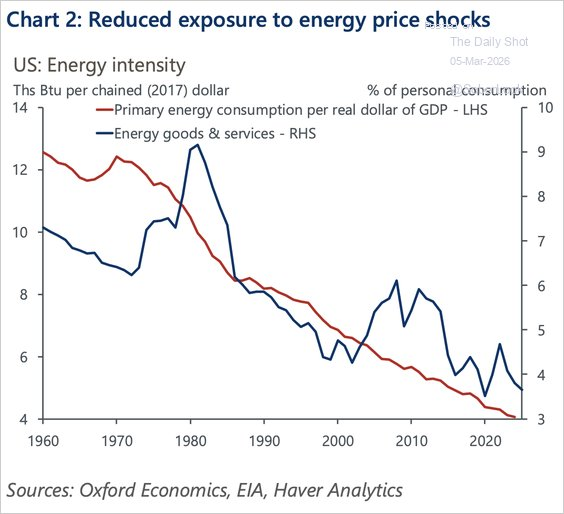
The graph below is important to consider when assessing how higher oil prices might impact the economy. The US economy has gradually become less vulnerable to oil supply shocks than in the past. Energy intensity, or energy consumption per unit of GDP, has steadily declined thanks to a more services-oriented economy, greater energy efficiency, and technological advances. The share of consumer spending going toward energy goods and services is also near an all-time low.
Furthermore, for those comparing today’s situation to the 1970’s oil price shocks, consider that nearly 100% of domestically used oil is produced in the US. In the 1970s, nearly 50% of oil was imported, making our economy much more vulnerable to geopolitical events at the time.
Tweet of the Day
“Want to achieve better long-term success in managing your portfolio? Here are our 15-trading rules for managing market risks.”
Please subscribe to the daily commentary to receive these updates every morning before the opening bell.
If you found this blog useful, please send it to someone else, share it on social media, or contact us to set up a meeting.